Translate

The content and opinions expressed in this blog are mine. They do not represent the US Government or US Peace Corps - Jud Dolphin

Saturday, June 26

Bangkok Part I


"We are recommending medical evacuation," explains my Peace Corps doctor? During my mid-service medical exam, several suspicious marks were found on my skin. The Peace Corps doctors suspected basal cell cancer - not the dangerous type, thankfully. They decided that the best course of treatment would be a visit to their medical back-up center in Bangkok.>

Bangkok was never on my "must see" list, but here I am being medically evacuated or as some light heartedly suggest going on a medical vacation or a "Medic-Vac."

I arrive at 4:00 am in the morning after a 9 1/2 hour flight from Kiev. I am anxious about new language and money conversion and getting a taxi especially at this hour in the morning. But as I step off the plane, I see that I can relax. I am in a very modern world class airport that is only a few years old. It is quickly becoming a hub for all of southeast Asia.

I am relieved that signs are in local Thai (a form of Sanskrit, I believe) and English. It is easy to navigate through customs and to the baggage claim. My final anxiety is also relieved. My back-pack comes circling around.

Outside I get a taxi. My driver speaks staccato. He only knows isolated words in English. Now I know how my beginner's Russian sounds to my Ukrainian friends. A word here and a word there, but not much of the connecting lingo.

I think he is talking about the recent unrest in Bangkok. He keeps making gun-shooting sounds like kids do when they are playing "shoot 'em." It's unnerving at 5:00 am especially when each "shoot 'em" sound is followed with laughter. I have to take several deep breathes to still my mind from racing ahead.

I need sleep.

After 20 minutes of a fast and thrilling ride, I reach the hotel. I am greeted by two doormen and a desk clerk who are all smiles. I mean these folks really know how to smile broadly. They greet you with palms together and a short bow too. I feel so welcomed.

My room is clean and simple like many 2 star hotels I have stayed in. I have all the basics and a comfortable bed.

I am bone tired.

The next day I see my doctor. The Bumrungard Medical Center is directly across the street from the hotel. The Peace Corps has made excellent arrangements even providing a specialized nurse to accompany me. She is great.

I enter a spacious lobby that resembles a 5 star hotel lobby. I see a Starbucks, a few shops and even a WIFI cyber corner amidst clusters of stylish sofas and comfy chairs. There is no institutional look here.

A young smiling Thai woman greets me in English. She directs me to the second floor registration. All is done efficiently, like America, and with even more friendly patient care.

My doctor is remarkable. He spends about 30 minutes examining and explaining treatment options. Several times he asks if I have questions and he does it in such a way as to invite questions. Can you believe it?

After a brief time in the waiting area where containers of juice and water are offered, I return for treatment. The doctor spends another 20 minutes taking a few biopsies and doing some skin freezing to prevent further problems.

I am delighted with the care. Procedures are in keeping with what I know of American practices and I never got the feeling that he was in a hurry to see another patient. In fact, he gives me a restaurant recommendations and even draws a detailed map on how to get there.

The next day is for sightseeing. I want to go to the Grand Palace and Wat Phara Kaew, a temple complex where the revered Emerald Buddha resides. Getting there is a challenge.

I study maps and metro stations. The streets in Bangkok seem like a jumble of pick-up sticks. As best as I can tell, each neighborhood has a main avenue with smaller streets that run off of it and then smaller allies that run off the streets. The streets in each area are numbered. The odd numbers run off of one side of the main avenue and the even on the other. It is quite tricky for a westerner to figure out. Missing is the predictable grid pattern.

I venture off to the Sky Way, an elevated Metro that has been in operation for a few years. Bangkok is notorious for constant grid lock. The Sky Way speeds you to your destination in a clean modern system. Stops are announced in Thai and English. I am impressed.

Unfortunately, the public transit only takes me 3/4 of the way. Now I must catch a taxi. My driver speaks no English and has difficulty understanding my map which of course is in English script.

It's a struggle or as I prefer to think during my better moments, a new adventure. Somehow after 20 minutes of traffic jams and making a wrong turn, we get to the Grand Palace and Buddha Temple. I have no complaint. The driver smiles and gives me a discount for the wrong turn.

The vacation part of my "Medi-Vac" begins.

Bangkok Part II

I have to remind myself that I am not on a Hollywood set viewing a remake of the King and I. It is astounding to be here and to see the remarkable architecture close up. It is so unlike anything I have ever seen in the West.

The Grand Palace complex was established in 1782 by a King Rama I. When he assumed the throne, he declared the old palace not suitable. So a new one was designed and constructed. Kings get to do it their way.

The complex consists of his royal residence, a series of government buildings and the highly renowned temple of the Emerald Buddha.

The colors are bright and intense. The design is graceful yet strong. And the craftsmanship is evident in delicate mosaics, intricate carvings and epic paintings. I stand there mesmerized Tourists, like me, are busy snapping pictures. In every direction there is something dazzling to see.

As I walk I hear chanting in the distance.
This area is also a functioning Buddhist Temple. People go to the Emerald Buddha to honor the teachings of Buddha. As was explained to me, Buddhism is not so much a religion as it is a teaching about living in harmony and peace.. Still this place is one of the most venerated sites in all of Thailand.

The Emerald Buddha is actually green jade. When discovered in 1434, it was covered in plaster. Nobody took it to be more than an ordinary Buddha image. But some plaster on it nose flaked away and revealed a lovely stone beneath. Mistakenly, it was thought to be emerald. Hence, the legend of the Emerald Buddha began.

The Emerald Buddha is quite small. In the temple, it's overpowered by a massive and ornate altar upon which it sits. Other Buddha images flank the altar. Epic paintings adorn the walls depicting the life of Buddha including his Great Renunciation and Temptations to Enlightenment. All is ablaze with gold.


I stop and take off my shoes and enter this sacred space. The ritual is simple. Kneel. Bow three times with face to the ground and then with palms together say your prayers.

Often I am told, people pray for loved ones who have died. I pray for family and friends who have died, some recently, and imagine them in a safe and satisfying state.

Outside people pause at a cauldron of holy water and lotus blossoms. They use the blossoms to sprinkle themselves and one another.


It's a respectful ritual but done with smiles and a little playfulness. In an oppressively hot climate where it is normally 90 F or more, water is a welcomed relief. And in a world as troubled as ours, holy water should be shared gleefully.

For several hours I wander the Grand Palace complex. Here are a few more images for you to enjoy....


With the sun still blazing, I find an outdoor porch and enjoy an entire bottle of cold water.
Thailand has known warfare and lots of strife, but there seems to be an inner tranquility. Then I meet a young man from Indochina. He tells me something remarkable. Thailand means "Land of Peace." I never knew that before and now I will never forget. What a wonderful place...I think I'll have another bottle of water.

Enjoy Budapest

Budapest is funky in a good way. At least that's my first impression as we check into the Lavender Circus. The Hostel's lounge is cluttered with 50s and 60s memorabilia. Silent films are playing on the walls and in the hallways. It works in a Elvis and Beatles sort of way. Andrea is our host and makes us welcomed by offering a shot of Palinka - a homemade vodka. It's powerful.

At the suggestion of Andrea, we're off to Castro for dinner. It's a hangout for locals with tables so close you could sample from a neighboring plate. Posters fill the walls with Che and Castro and the Beatles sharing space in a psychedelic montage. Anyone over fifty knows the scene. Why didn't I bring my bell bottoms?

Next morning it's breakfast at The Central Cafe. Andrea tells us that it's a historic cafe and a favorite meeting place for artists and assorted rebels. "Imagine the plots discussed here," I say to Fran. "It's a place of elegance and intrigue." We savor our eggs and coffee latte and make our own plot for the day.

Budapest was united in 1873 when two separate cities came together forming Buda-Pest.
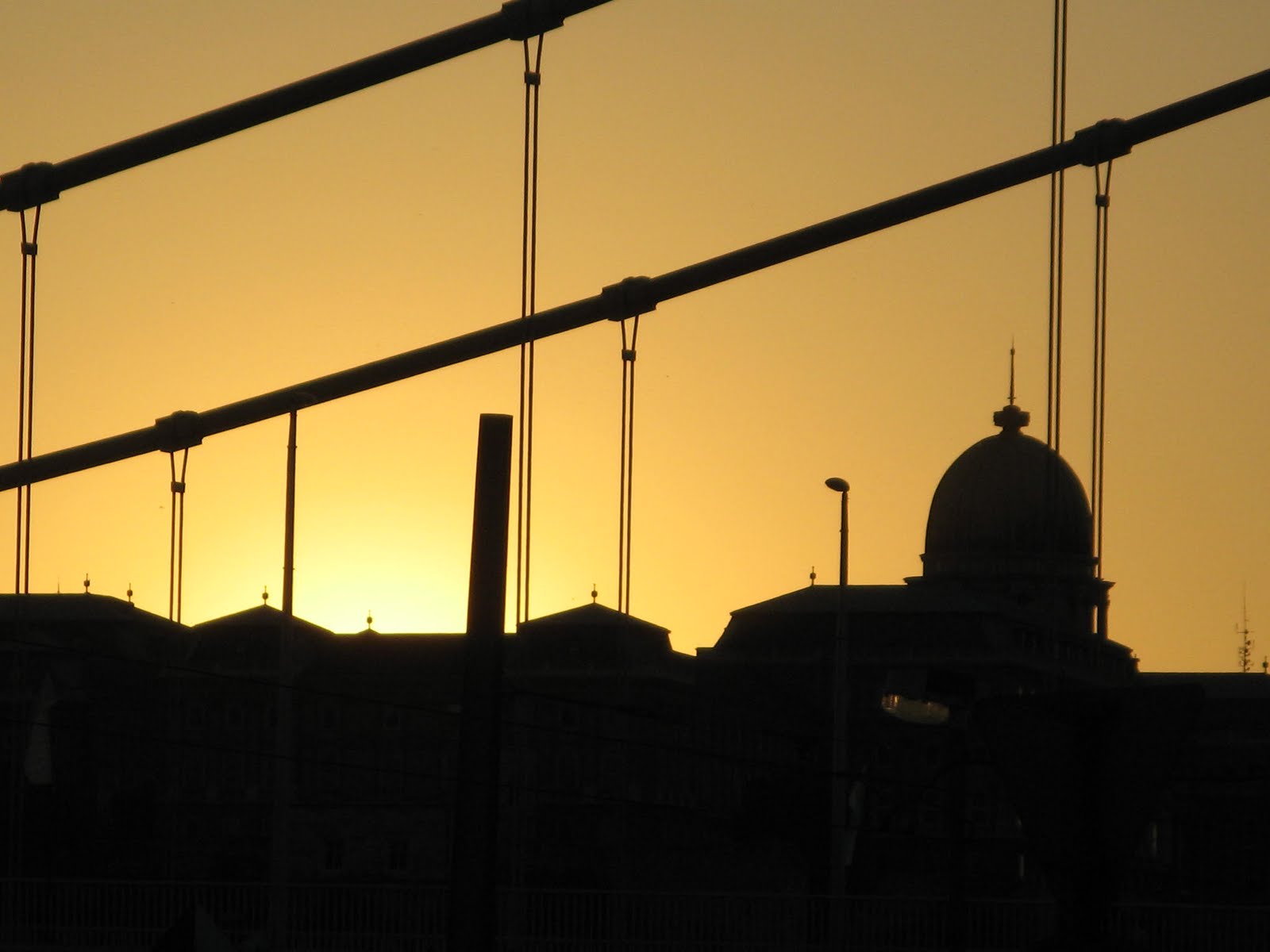
Beautiful bridges now span the Danube lending elegance to that union. There has been settlement here since before Roman times. During the Renaissance, Budapest became a hub of trade and culture.


The people have survived through many invasions and occupations. The Nazis and Soviets were the most recent.
In 1956 the Hungarian Revolt was the first crack in Soviet solidarity and foretold a different time when oppression and occupation would end. Through it all, I think the Hungarian spirit was never broken. It waited for the right time to breathe free again

Budapest is a delight to the eyes. Splendid architecture is around every corner. I read in a guide books that it's like the Paris of Eastern Europe. Maybe that's an overstatement, but not by much. The cityscape is like a massive painting. I can't wait to see the next scene. I take way too many photos, but I cannot help myself.


What makes these architectural treats so remarkable is the destruction that Budapest suffered during the Great War. More than 80% of the buildings were hit by bombs. I am not sure why, but the Soviets spent a lot of money and resources to bring the city back to the elegance we see today.

At night Budapest becomes magical. It's a city of lights spanning the Danube. Stroll along the river. Stop at a cafe for a glass of wine. Watch the sun slowly set over the Danube and hills beyond. Soak in the beauty of a city opening to the night.


Next day it's off to Castle Hill. Like bookends, the hill is framed by Mathias Cathedral and a Castle with lesser buildings in between. We ride an incline to the top and get a panoramic view of Pest. It's beautiful.


Matthias Cathedral has a 700 year history and is an icon of the Hungarian spirit. Tural, a mythical guard bird, keeps watch from pinnacles.
Even with Tural's watchfulness, the Cathedral has been sack and rebuilt several times.

During the Ottoman Empire occupation, it was converted into a mosque. Mosaics were white washed into oblivion and all images removed as required by Islamic practice. A statute of Mary was hastily hidden behind a false plaster wall. A century later when the Hungarians sought to oust the Turks, a volley of cannon balls broke through the plaster wall and Mary miraculously reappeared. So stunned were the Turks that their morale was broken and they lost the war. The Cathedral was once again Christian.


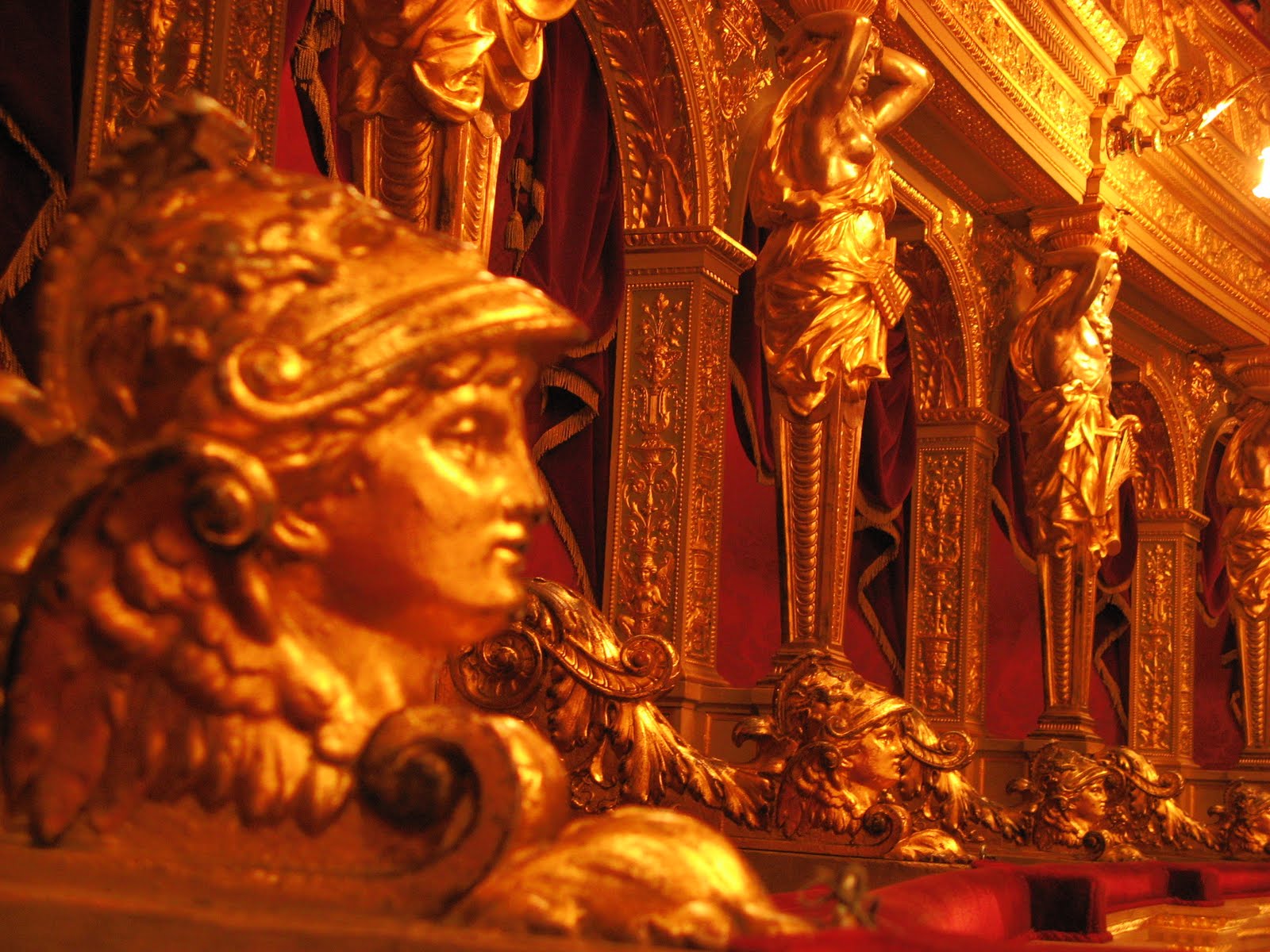
We extend our visit in Budapest and get a chance to try out a new Hostel. This one is next to Budapest Opera House. I'll long remember a late afternoon siesta with summer breezes waffling though tall windows as an operatic soprano rehearses across the street. Does it get any better?

We buy tickets for a world premier of a modern ballet. The grace and energy communicates emotions without words. Music and movement unites a diverse audience with the performers.
In one piece the audience is so absorbed that for a few seconds we forget to applaud. Then we remember and we applaud and applaud with deep gratitude and roses are flung onto the stage. Bravo!

A growing heat wave sends me to the mineral baths. Budapest is on a fault where natural mineral springs percolate streams of hot mineral rich waters. Locals and the government claim healing benefits.

I go to a bath with more than 18 different pools inside and out. Some are for swimming and others are for soaking. You can even visit a sauna and then jump into near freezing water. Brisk and refreshing, they say. I do not try it thinking that my heart will thank me.

I spent lots of time swimming followed by soaks in progressively hotter water. I must report that after a day lounging in baths, my body fells like a 35 year old. Gone are minor aches, especially my soar feet. I feel rejuvenated.


I love Budapest.


It's funk.


It's architectural beauty.


It's culture.


It's enduring spirit.


And yes, a cool swim on a sweltering afternoon.


Saturday, June 12

Part I Auschwitz - Birkenau

It's 1945. A new life begins. From the moment of inception, cells begin to divide. Hundreds, thousands and millions growing and forming tiny legs and arms and fingers. Skin and bone mold a unique face within the womb. Soon a baby will press out and into the world. He will be named Judson Wesley Dolphin.

At the same time in 1945, there is death. The Concentration Camps of Auschwitz and Birkenau are multiplying their victims. Lives are ending to soon and too quickly. Mostly, the bodies in those Concentration Camps consumed themselves. With less than 1000 calories and more than 11 hours of hard physical labor each day, the cells have no choice. They consume one another to survive if only for another day.

Legs and arms loose muscle mass becoming tiny again. Skin seems translucent sagging like wet tissue paper on bony protrusions. Faces dim becoming devoid of emotions. It's like the soul is trying to lessen the horror in some vague way.

Slowly cell by cell, life is taken away. The process will be repeated 1,500,000 times in these two places. Later in 1944 and 1945 gas will hasten the process and crematories will clean up the mess. Mass murder has its own learning curve.

I am visiting the Concentration Camps outside of Krakow Poland. My Friend and travel companion, Fran, says, " I don't want to go, but I must." I feel the same. My life began just as these places became known and the world vowed "never again." I cannot help but feel a human connection. I both want and hate the idea of seeing these places for myself.


Electrified Fencing at Auschwitz

It's about 90 minutes bus ride to Auschwitz from Krakow. Tidy country homes dot the countryside. Fran and I point out the sights to one another from our bus window. All seems so normal and beautiful. The fields are sprayed in deep summer green. Splashes of red field poppies add enchantment. Life is beautiful.

Yet I remember that in 1945, human bodies came in this same direction. Routinely across these fields and hills, they came to Concentration Camps. Legs and arms stuffed into railroad box cars which were meant for animals. With no food or water and barely air to breathe, bodies came from all over Europe. Auschwitz was selected because of its central location. Originally for Polish prisoners, it would now leave a legacy of death for Jews and Gypsies and Homosexuals and other so called political and social misfits.

A film of those years is shown on the bus. A young Soviet photographer captured the pictures as the Camps were liberated. He says, "Time can never erase these memories."

I see for myself. In my mind's eye, images appear as if they are ghost reflections on the glass surface of the bus window. They appear for a few moments and then disappear as the beauty of the countryside takes over. But no, the images cannot be forgotten and even more await me as I draw closer to Auschwitz.

First Crematoria at Auschwitz

Friday, June 11

Part II Auschwitz - Birkenau


The contrast continues at Auschwitz. Pounded out in wrought iron letters and hanging between posts at the front gate are the cynical words - "Work will set you free."

I walk through the gate and have my first look a Auschwitz. Immediately, I notice the neat orderly rows of brick buildings. They look like dormitories on a college campus.
But Inside, prisoners were kept 3 bodies to a bunk stacked three high. Displays tell the story of what went on here from 1940 to 1945.

Originally, Auschwitz was meant for Polish prisoners. They would be brought here and worked hard until disease or starvation ended life - usually within 5 months.

Latrines where prisoners would often hide

Our guide tells us that names and faces were problematic. The Nazis had an insatiable need to be in control of everything - even those they murdered.

At first they took photos of those who came to the Camps so that they could identify who died. But the Camps were growing quickly and the need to process more bodies made photos impractical. Besides as the body eats away at itself, appearance changes making absolute identification uncertain.

Uncertainty was a threat to Nazi supremacy. So they developed the practice of tattooing numbers. Match the numbers with the record card - Nazi certainty. When Ally troops liberated children in 1945 and asked their names, the children simply pointed to the numbers on their tiny arms or legs. Names no longer mattered.

Somewhere around 1942, the ideology of racial supremacy connected with the efficiency of Concentration Camps and created a mechanism for mass extinction. The Nazis were learning how to handle hundreds of thousands of bodies.

Separate women and children from the men. Get rid of the children first and then the mothers. They have no work value. One of the lasting images is a large display case with little children shoes. My stomach actually gets acid reflux as I spy a clump of baby booties in the mound of remains.

Our guide tells us more about the sorting of human life. With a quick nod, doctors ordered healthier men to the work barracks and sick ones to the hospital and certain death. A jumble of eye glasses, maybe several thousand, are in a display case. I take my glasses off and hold them next to the pile with only glass separating us. I shudder, but not quite silently.

Nazi lust for racial purity lead to many twisted enterprises. Doctors experimented on women in search of an injection that would cause sterilization. Injections had an advantage over gassing. There would be no body refuse to clean up. In this medically clean way, Nazis could rid the world of other undesirables, like Slavic people, after they had taken care of the Jews.

Remains of Baracks

The killing machine expanded. An adjoining Camp known as Birkenau was started. Unlike Auschwitz where people had to walk from a train station into the Camp, at Birkenau, the tracks came in through a narrow gate and spread out across an open field.


After the initial sorting, women and children were promised a shower at one of 4 buildings on the far end of the field. They walked along the train tracks to their death.

I walk the same train tracks from the crematories towards the open gate. I count the railroad ties separating the two. There are over 4,000 withe each tie being a step. How long does it take to walk 4000 steps? How long until life is showered away?

The sun is blazing hot with temperatures more than 90 F. Step by step, a strange image enters my mind. It seems like I am walking along a kind of birthing canal.

Visually I see the opening of the gate. Except this one is in reverse. It starts among the living in the outside world and draws human life into a womb of death.

Birkenau was so efficient. The exact number is unknown, but our guide says about 1.500,000 died here including more than 235,000 children. They say that 95% of all Jews brought to Auschwitz-Birkenau were dead by 1945, the year of my birth.

Slowly I walk the train tracks and count the ties and think about living and dieing.

I remember an Elder from Trinity Presbyterian Church in Pittsburgh. He once told me to be careful about too much religion and I would add now, about too much ideology. I dismissed his advice at the time being a bit of a zealot myself, but as years have passed I understand his wisdom.

It seems to me that whenever any group believes that they have unshakable certainty, no good will follow. It matters little if it be the Taliban in Afghanistan condeming moderism or the Christian Radical Right condemning homosexuality. Certainty in a cause breeds intolerance and soon breeds hatred.

Sometimes people are willing to sacrifice freedom and life in order to have their own way enforced. I think it's a kind of lust for control and power. Sure we can wrap many rationalizations around the certainty of our cause and give it a more respectable appearance, but I think it stills eats away at human life.

I want to remain a skeptic. Maybe the horrific legacy of 1945 can be a reminder. There is no good in having it all figured out. Life is a beautiful mystery. Uncertainty always opens space for living freely.

What do you think?

Monday, May 10

Just a Bike Ride

My cell phone rings. "Are you planning to join us for the bike ride," asks Anton. He is a student at the Konotop Institute and parliament president. I got to know him through my organizational development seminars.

About a week ago, he suggested that I might enjoy a bike ride. I think he saw my bike at Hearts of Love Center. Since the weather turned warm, I have been trying to ride several times a week.

Mine is an old Soviet bike which was given to me to use for the duration of my stay in Konotop. It has those thick tires and old fashioned coaster brakes. I had to relearn how to peddle backwards in order to stop. Yikes!

There's nothing sleek about this bike. I think it weighs about 100 pounds or at least it feels that heavy when I want to ride and must first haul it down and then back up 4 flights of stairs.

I agree to join Anton for the bike ride. I am thinking, “Great fun joining a few university students for a ride on a pleasant spring morning. So I pump up my tires - Eat a protein rich breakfast - Haul the bike down the stairs - Put on my helmet - And start peddling.

Casually, I make my way to our meeting spot in the center of town. As I turn the corner, I am totally surprised. The unexpected greets me.

About 200 young bikers are massing in front of the Post Office. A few adults are busy organizing the chaos into rows as if the bikers were soldiers getting ready for a parade. My ride with a few friends is actually a healthy life style event for all of Konotop's kids.
Bikers gather for the Healthy Life Style Event

No problem. I will just blend into the back row. Ha! Who am I kidding?

First, I am the only kid with a helmet. Second, I’m no kid. In fact, I am the oldest person within sight. Third, my bike is straight out of the 1950s Soviet Sears and Roebuck Catalogue if they had such a thing. I am as conspicuous as a Soviet flag would be at a 4th of July celebration.

Anton greets me with a video camera. He tells me that he won’t be riding but capturing the day digitally. A TV crew is here too. “Great,” I think, “now there will be a record!”

Before I know what is happening, I am in the front line of all the bikers. The plan is for the American and two others to lead the pack. Me - in the middle, leading 200 kids on bikes. Can you believe it? Yikes...Leading the way
Adrenalin pumps and deep breathes calm my nerves, barely. We are off on a 3 kilometer ride with eager kids nipping at my back tires. Luckily it is rather flat terrain in Konotop and the only hill is towards the end. I chug up the hill with a few kids passing by. I blame it on my chunky tires.

We swerve into the school yard all smiles. The next few hours will be filled with competitions. The kids line up to participate in everything from chess to arm wrestling to hoops to badminton to tug-of-war and more. On a stage there is Ukrainian singing and dancing. There’s even a Kung Fu demonstration. The kids are particularly attentive as leg blows are traded.
Anton tries on my helmet

What a wonderful day, it’s turned out to be. It’s not what I expected, but I’m thinking, “This is Ukraine and it's my first bike run ever. Wow, I made it.”

Visiting Blessings

I have known them as a couple since 1956. They met in high school and have been married for 48 years. I remember rocking their first child to sleep. Now she is all grown up and has children of her own.

The cause of my reminiscence is a Ukrainian visit by my brother, Warren and my sister-in-law, Judy. When I was younger, I don't think I appreciated their effort to keep in contact with family as much as I do now. Now I relish their visit.
Brother Warren

Judy and Jenny

They have multiple reasons for visiting Ukraine. Top of the list are two grandsons, Brendan and Aidan. My niece is married to an military officer and he along with the whole family are now living in Kiev. In one of those odd coincidences, he learned about his assignment two weeks after mine. It has been a wonderful blessing to have family close and now a visit from Warren and Judy.
Brendan and Grammy

Aidan and "Great" Uncle Jud

I meet them in Kiev having decided that placing them alone on a train might be too much of a Russian language adventure. I remember my panic. They are grateful. My brother calls me his lifeline. I chuckle to myself since all of my life, I have looked up to him.

The train ride to Konotop is uneventful. I brought a bottle of wine along. So we sip it from plastic cups and Judy and Warren get a look at the Ukrainian countryside captured like snap shots through the smudgy train window.

"It's very flat, even more than Iowa" remarks Judy. Warren notices a lack of storage silos and processing plants. Both wonder where the live stock is hiding.

Ukrainian land stretches from horizon to horizon without interruption. What does get cultivated is often done by hand. We see miles of thick dark black earth and in the distance, small figures bend over as generations always have done. Spring means days of back-braking work.

In the future, whenever I think of some overwhelming task and feel like giving up, I will remember the figures preparing the soil row by row by row. Progress is painfully slow, but they do not give up. With much toil and constant bent frames, their bodies offer a kind of kinetic prayer, - "Grant us a harvest again this year. "

Konotop is buzzing with excitement. A special Tea Time is planned at Hearts of Love for 1:00 pm. Friends are making arrangements to leave work so that they can greet my brother and his wife. Later in the night we will be hosted at a home for a traditional Borscht dinner.

Meanwhile, we sightsee Konotop and enjoy the perfect Spring weather. A short trip to the Konotop Aviation museum is disappointing. It's closed on Mondays. We still get to see the helicopters through the fence under watchful eyes of a guard.

On our way back we notice a small church. The gate is open beckoning us forward. A few men and what appears to be a special needs teenager are clearing winter debris from the yard. Several women are inside methodically cleaning the floors on their hands and knees.

We hesitate to enter, but their warm smiles and gestures urge us inside. The Church is a year old made from recycled bricks that may be a 100 years old. The altar is constructed of plywood and has yet to be covered in the ornate Russian Orthodox style.

For now, beautiful cross-stitch hangings cover the walls. Judy, who is an avid sewer, admires the handiwork. It is amazing what you can communicate with warmth and body language. She does not really need a lifeline.

The rest of the day is consumed with eating Ukrainian style.

At Hearts of Love, tea time has been transformed into a luscious lunch. We are treated to lupsky (cabbage rolls), a fresh salad, veggies, crepes and many sweets.

My brother presents a wooden cutting board to Yelena as a token of appreciation and friendship. He hand-crafted it and by the look on her face it will become a treasure.

After 3 hours, the meal ends and we say our farewells. We walk down the gravel and dirt paths towards Konotop's only hotel. It is actually quite nice. We have an hour to try to recover an appetite before our next eating engagement.

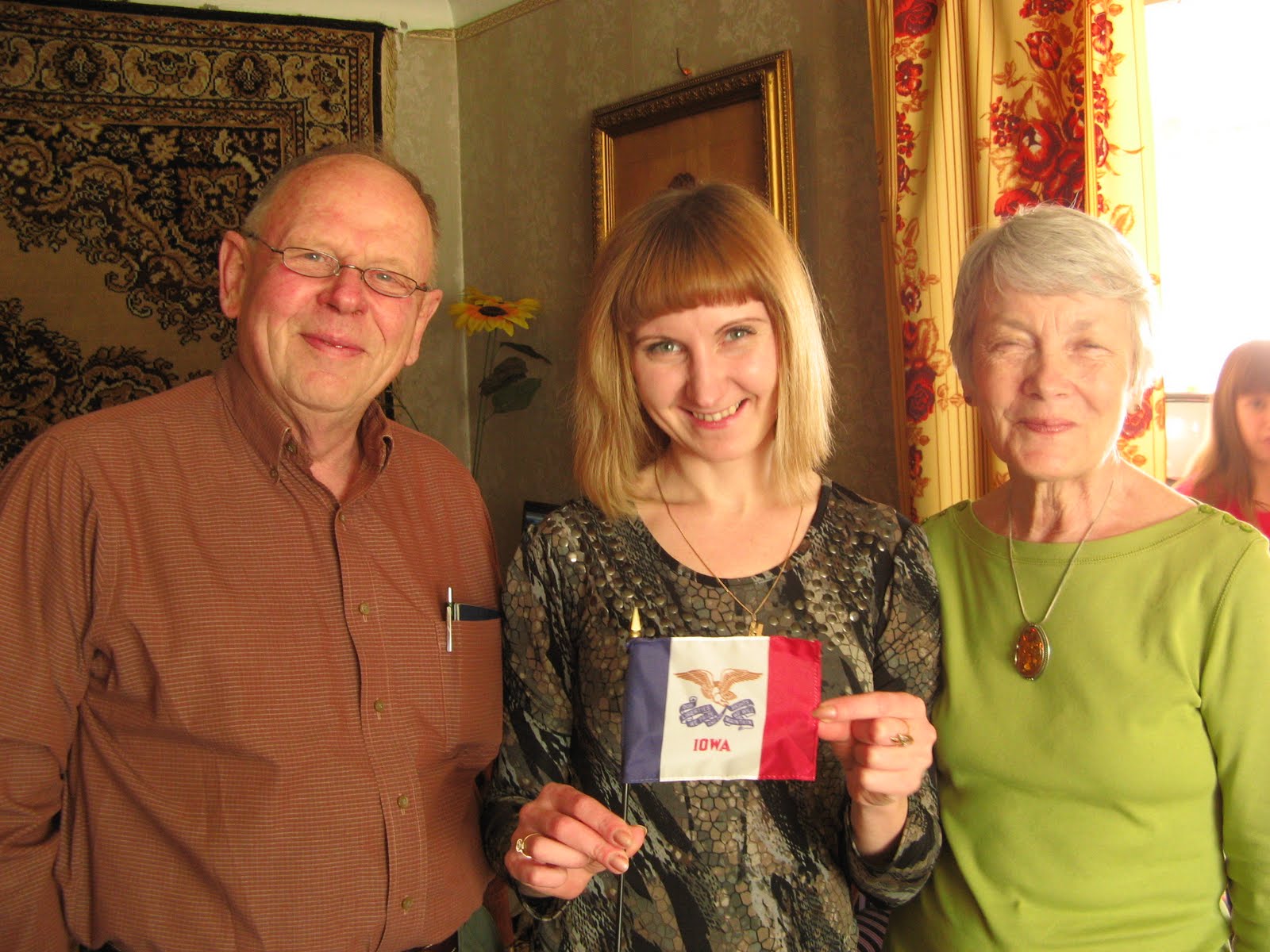
Natash has set a luscious table. Surprisingly, an Iowa State Flag is part of the center-piece. Immediately Warren and Judy wonder how she came about having such a flag on a table in Konotop.

It seems that she went to America for a leadership conference at Iowa State in Ames Iowa - where Warren and Judy lived most of their lives. Even more fascinating, Natasha brings out a scrap book with pictures of several friends Judy and Warren new well. Instant rapport.
Set before us are big bowls of borscht. Each one is like a serving dish. It's absolutely delicious. Natasia and Babushka have worked most of the day preparing this special meal. Ukrainians, like many people, show love by with hospitality. Appetite or no appetite, Warren and I make room savoring each spoonful. Judy does well too.

Judy is amazed that all the careful chopping and dicing is accomplish in such a small kitchen. There's a small table and about two feet of counter space.

Space is limited. It's one of the differences that Americans normally notice.

Americans need physical space for privacy while Ukrainians create a kind of mental privacy. Close proximity without communicating is normal. We Americans feel a need to fill spaces with words and if we can't, we grow increasingly uncomfortable until we leave for another room. Ukraine families have few places to escape. It is not unusual for a family of six to live in 2 or 3 rooms.

The next day, It's off to Chernigov and a visit with my host family. Ksusha takes leave from work to be our excursion guide. Her English is excellent though she confides that Americans "do speak quickly." .

Chernigov is an ancient city and many of the world class landmarks remain. We walk towards ancient churches amidst a colonnade of Soviet heroes. Take a look and see for yourself.


Honoring the soldiers, patriots and underground partisans of Chernigov land


St. Parasceve Church
dating from the 13th century


Boryso-Hlibsky Cathedral dating from 11th century


Chernigov Collegium 18th century

My Ukrainian family is delighted to meet Warren and Judy. We have a lovely dinner together as we sip wine and become better acquainted.

Andre and Natasia, whose wedding I attended,join us as do Pavil and Ksusha who may get married this Fall. Pavil shows me some of his design work for office furniture. He works with his father in a small fabricating shop. He is the design brains behind the products. His work is really quite good.

My brothe and Pavil have something in common. They both create with wood. I feel like I am introducing family to family. It's wonderful.

The next day we wander through the extensive Bazaar until we happen upon the used tool section. I knew it would happen.

Warren loves collecting tools - not as show pieces but as useful instruments for his excellent wood working. He is like a kid in a toy shop. He must see every aisle at least once, maybe twice, but who is counting.

Too quickly our visit comes to an end. We head back to Kiev in a Marshrutka. Flat fields accompany us with occasional villages and the odd sight od stork nests afixed atop telephone poles. I see a few baby storks peeking from nests and looking for their mothers.

Jenny and Jud

Judy plays peek-a-boo with a child in the seat ahead. Both communicate in the universal language of giggles. I smile too. I get to thinking about family and realizing how blessed I really am. Thanks for visiting.