Translate

The content and opinions expressed in this blog are mine. They do not represent the US Government or US Peace Corps - Jud Dolphin

Monday, February 28

A Toast for Civil Society

"Let me say a few words...a toast to so many walls falling down...no longer afraid...we are open and can talk our minds...friends without fear and barriers," smiles Natalia, the Director of the Institute of Leadership and Management of the Ukrainian Catholic University.

I am with her and two of her team members relaxing over dinner after a long day that included my seminar on Practical Public Relations for NGOs (Non-Profits).

Her toast comes after an extended conversation about struggles for a civil society and lingering consequences of Soviet rule. Although it's been 20 years, I am continually struck by the dark depth of this legacy. It seems like Soviets in an effort to control human thinking left deep scares marked by fear and isolation.

(Courtesy of Suzanne Cochran, Peace Corps Volunteer)
"As children, my brother and I went to Holy Friday worship services with my mother," Natalia shares. "It was held at night because in the dark, it is not so easy to see who is going in and coming out."

She tells about a time when they were observed by authorities. The next day at school, she and her brother were taken into a room and reprimanded. "Good Soviet Pioneers (a Soviet children's program) do not go to bad places. Only bad people go to churches." As Natalia says, "We learned to stare a hole in the floor and never say a word."

The Soviet system imploded in 1991 and Ukraine rose up declaring its independence. The world would need to learn that this land was no longer "The Ukraine" as if it was a section of a larger country, but simply Ukraine, a fully autonomous nation.

I remember having to learn to drop the article "the" when I first came to Ukraine. The Soviet legacy was a part of my mind too. It may seem like a simple or even silly grammatical change, but it is more. It is about identity, human dignity, freedom and hope for a better life.

I am in the west of Ukraine in the city of Lviv. It's a 13 hour train ride from Konotop and a mere 85 kilometers away from Poland. During much of Ukraine's history, the area around Lviv has been been annexed by one empire or another. Poles, Lithuanians, Astro-Hungarians, Germans and of course Russians took turns. Still through it all a remnant Ukrainian identity survived. And now since 1991, there is but one Ukraine from Lviv in the west to Kiev in the middle and Donestk in the east.

My seminar brings together about 30 NGO leaders. Each is engaged in some form of community service or charity work.

It's remarkable.

Back in Soviet times, there was no entrepreneurial leadership. If it was not done by the State, it was not needed. You did not embark on your own. To do so was to invite danger to yourself and your family. So many Ukrainians have told me that they got real good at being invisible and just blending in. 

It reminds me of the old Beatles tune - "He's a real nowhere Man, Sitting in his nowhere land, Making all his nowhere plans for nobody..."
So truly it is remarkable to see so many leaders eager to learn and increase the effectiveness of their NGOs. These men and women are building the structure for a more civil society. Association by association, network connection by network connection, the slow process of regaining a good life is happening.

A mother talks about her son with autism. "They told me he would be nothing and should be kept at home and out of sight." She rebelled, went to school to learn about treating autism and now heads a small organization that gives hope to other families.

A young fellow, maybe 28, is working to resurrect Ukrainian culture and teach the next generation about the traditional ways. He is planning a cultural festival in Spring and is eager to learn about press releases and press conferences and how to spin a story into news.

An older woman talks about uniting pensioners so that they can speak in one voice. Her organization is part social and part advocacy. Immediately I think of AARP and the similarities of how it got started. I share lots of ideas. She can't wait to check-out the AARP web site - http://www.aarp.org/

A woman tells about a mini-bus that travels the streets of Lviv giving HIV tests and AIDS information. "A lot of time people don't notice us," she laments. We discuss placing colorful circle and a banner on the bus so that it stands out. I suggest, "Maybe a radio station will play a game and ask listeners 'where in Lviv is the HIV bus today!'"

We have a lot of fun. Thanks to a wonderful translator, I can freely share practical ideas, antidotes and even a few jokes. We all have a laugh when I use a colloquial expression and my translator stares at me in disbelief. "What will he say next?"

Even though the Seminar goes on for more than 6 hours, most of the students stay. They are so eager to learn and grow their organizations. It's a delight to be with them.
It's like seeing a kind of transformation. Silent head-bowed obedience is being replaced with animation and tons of questions. The human spirit lives. Minds can think new ideas. People can associate in new ways. Civil Society emerges.

So, dear friend, I invite you to join us. Say a few words and offer a toast. Americans and Ukrainians, we are friends without fears or barriers. Let us help one another live into a good life.

Saturday, February 12

Egyptian Antiquity and Tahrir Square


More than 4000 years ago, a moral conscience developed among Egyptians.  I have been reading Development of Religion and Thought in Ancient Egypt by James Breasted.  

Absorbing the evolution of ancient thought as I watch 21st century history unfold in Tahrir Square has created a remarkable convergence of underlying truth.  I realize anew the depth and strength of the human spirit.  It cannot be denied. 

In this civilization along the Nile, people created a cradle for our civil society.  From prehistoric roots, they developed the first awareness that social behavior is linked to human development and the will of the gods.  Some experts say that their social consciousness was well established more than three centuries before the Ten Commandments.  

Even Pharaohs are subject to judgment.   Carved into the walls of their tombs are pleas of innocence.

“I did not slay men.  I did not steal from one crying for his possessions.  I did not take away food.  I did not diminish the grain measure.  I did not commit adultery.  I did not stir up fear.  I did not stir up strife.  I was not avarice.  I was not puffed up.  I did not make falsehoods in the place of truths.  I was not deaf to truthful words.  My heart coveted not.  I did not wax in hot temper.  I did not do an abomination of the gods.” (Adapted from Book of the Dead, translated J. Breasted, pp302-303)

Injustice does not stand.   As Martin Luther King said to a powerful country still needing to address its own injustice, “…the arc of the moral universe is long, but it bends toward justice."

Before January 25th and the start of the protests in Egypt, I was emailing Omar.  You may recall him as the artist I met in the Egyptian Museum, just a few blocks from Tahrir Square.  He was the one who recommended a cafe on Tahrir Square.

I did not know then that the cityscape I was exploring would soon be filled with tanks, military and millions of ordinary Egyptians fed up with the dictatorial system .   

Omar writes one week before the start of protests:

“the weather here is kinda cold, winter break just came by, my birthday in 2 weeks and my 6 months anniversary with my girlfriend, I am really excited about the 2nd one because I really think she is the one :)

I am starting my own company too; Vinyl designs - as in records not the material :D - , WISH US LUCK.  WE NEED IT!!!

best wishes from the ever green Egypt :)”

A very normal and friendly note from an almost 21 year old.  It’s what you would expect and then a few days later I receive this email:

“Hey Jud

how are u doing?  yea things have been crazy the past week! a lot of people escaped prisons and were stealing malls and homes.  i almost got shot like 6 times and i almost killed a man.  feels weird but thanks god me, my family and our home are unharmed.  the good thing is that people are uniting again, everyone cares about the other and our love to our country got restored.  pray for us.  btw i am 21 on the 7th :D”

I honor his request for prayer and celebrate his birthday by sending a home-made birthday card.  I write the following to him:

“I am very glad to hear from you.  It must be a very scary time but also a time for much needed change….

I can only imagine the fear of being shot at and the terrible feeling of almost shooting another.  I am glad you were spared that experience.  May it continue.

Are you sleeping on the square?  Are you protecting your area from criminals?  I of course will pray and trust that good outcomes will happen for you and your country. 

I will celebrate your 21st Birthday on Monday.”

I assume Omar celebrated his birthday on Monday, but did not hear from him.  Of course, I worried as the stalemate became more intense.  The news had a face and it was Omar's.  Then history was made on 2/11 and Omar wrote:

“YOU HAVE NO IDEA HOW HAPPY, ALIVE AND DIGNIFIED WE ARE AT THIS MOMENT  I CRIED OUT OF JOY! I COULDN'T BELIEVE IT!!!

it has been a long journey, I myself almost got ran over twice, almost got shot 8 times
and full of bruises and scars now.  i have lost friends and i ve seen bad things
but i gained freedom and got my country back :D”

Like all the commentators say, Egypt has so much to accomplish for freedom and justice to flourish.  But this is a land and people who first gave voice to our higher ideals.

Like a kind of unintended immortality, we have the words of justice inscribed on the walls of ancient tombs.  Even now they strengthen our human spirit.  I have a feeling that something good will emerge and I think my young artist friend will be a part of it. 

Omar, God bless you….

Civic Engagement and Service Learning

“Can you help us develop a grant for Civic Engagement,” comes the invitation from Tatyana, the Director of the Poly-Technical School?

Tatyana is a graduate of an American Exchange Program that took her and a few others from Konotop to Ames, Iowa.  Now there is an opportunity for a grant to further Civic Engagement locally.

I arrive for a meeting.  It’s a small world.  By coincidence, my brother and his wife lived in Ames for most of their married life.  Warren taught biology at the Iowa State University and Judy directed the campus YWCA.  They never met Tatyana, but amazingly they share friends in common.  Because of this Ames connection, I think Tatyana and I share a special friendship. 

Her request to help develop a grant comes unexpectedly.  Initially, I have no idea what to suggest.  I fret about it for a couple of days before the meeting.  I am honored to be asked and increasingly I’m afraid I have nothing to say. 
  
As a last gasp for something, I start looking at my Peace Corps Training Portfolio.  I’m looking for ideas, any ideas.  But there is nothing.  I sort through more files and dust off my assortment of how-to manuals.   I am getting desperate.

Suddenly, Service Learning jumps out at me.  In the first summer of my Peace Corps experience, I attended training about Service Learning.  


When I returned to Konotop, I tried to interest a few people, but it went nowhere.    I placed the how-to booklet behind my shoes in the bottom of my armoire.  It stayed there until today.

I quickly research the idea on the Internet and put together a one page fact sheet translated into Russian.  I put a call through to the Peace Corps Office and get them to send me all the materials they have on Service Learning.  Strikingly, they have been translated into Ukrainian.  I am soaring high.  Who would have thought that such a great idea would be lying dormant in my armoire?     
Briefly if you don’t already know, “Service-Learning is a teaching strategy that integrates meaningful community service with instruction and reflection to enrich the learning experience, teach civic responsibility, and strengthen communities. “   


(http://www.servicelearning.org/what-is-service-learning)
 I think it is a perfect  idea for Civic Engagement.  At our meeting Tatyana agrees.  She asks whether Service Learning is common.  I say, “It’s growing in America, but maybe not so much in Ukraine.”  She smiles and says, “Maybe we will be the first.” 
But there is more.  Tatyana goes on to explain that she is finishing her doctoral degree on educational pedagogy emphasizing engagement of students.  We both see a wonderful merging of her academic work with Service Learning and this grant opportunity.
Others are called into our meeting and soon assignments are made to develop the grant.  I will help with the English translation. 
I leave the meeting with a glow of satisfaction.  Sometimes all the pieces do fit together.  In another small way, the Peace Corps is making a difference in the world.  

Monday, January 31

Call for Compassion

It's strange to look at a CNN photo of the Egyptian Museum with fully armed tanks rolling down the street from the very spot I stood just a month ago.  Gone are the traffic jams replaced by armed power and fear.


I have no great insights about the whys and wherefores of yet another world conflict.  It just seems to me that the world churns onward with too many many reminders that we need more justice, understanding and compassion for the entire human family.  Maybe it sounds corny, but surely it's needed.

As chance would have it and while I am doing research on an upcoming seminar on marketing for NGOs,  I stumble upon a video and the Charter for Compassion.  www.charterforcompassion.org

"What's this," I say to myself?   With a click, I take a look.  It's a remarkable video and an inspiring message.  I think, "Maybe this message can infiltrate the human family in a new way and empower a little more justice, understanding and compassion.  So I will pass it along and who knows where and what it will do."

Sure it's not solving desperate problems and maybe it's a little corny, but with a little more justice and understanding and compassion....

Tuesday, January 18

Trains, Temples and Stars

Images of antiquity seem ubiquitous. They’re available in picture books or on our computers whenever we want them. Las Vegas gives us Pyramids and the Sphinx in miniature. It’s easy to think, “ We've seen that before,” and glibly move on.

But today, I’m surrounded by the real thing - a formal colonnade inside Luxor Temple. I’m impressed and stand in wonderment. I can only imagine the awe people felt 3500 years ago when they stood in the same place where I am standing now. They had no pictures, no miniatures and no buildings as tall as these towering structures. The sight must have shaped their thinking and conveyed a deeper meaning.

Fran and I travel to Luxor via a day train. We want to see the countryside and catch glimpses of ordinary life. The seats are comfortable and the windows are grimy giving my photos an antique look. The trip will take all day and then some. It’s about 450 miles following south along the Nile Valley.

Outside it’s lush green. The Nile through a series of canals certainly transforms the desert. It’s as if someone has drawn a dividing line - water and green vegetation on one side and dry desert on the other. It’s a remarkable to see how the Nile makes life possible.

Interestingly, the Aswan Damn, which is further up stream (south), now controls the periodic flooding. Water flow is carefully measured out. Peasants use gasoline powered pump to lift the water from canals. Their fields are laid out in 15’x20’ plots with raised walkways to contain the water. It creates a kind of green patchwork quilt.

Unfortunately, they no longer get the benefits of rich black soil that flooding had brought since the dawn of recorded time. Now they buy fertilizers from chemical companies.

I spy a family tending their field. They’re dressed traditionally like we use to imagine when we dressed up for the Christmas pageant. Long flowing robes called Gallibya cover from neck to ankles. A head wrap protects from the sun.

It’s a quaint picture for a westerner though I am sure it is anything but a quaint life. I know a little about rural life in Ukraine and this seems more severe.

I see no mechanization except the water pumps. The family works the field on their hands and knees. They are cutting what I believe is alfalfa. It's feed for their animals.

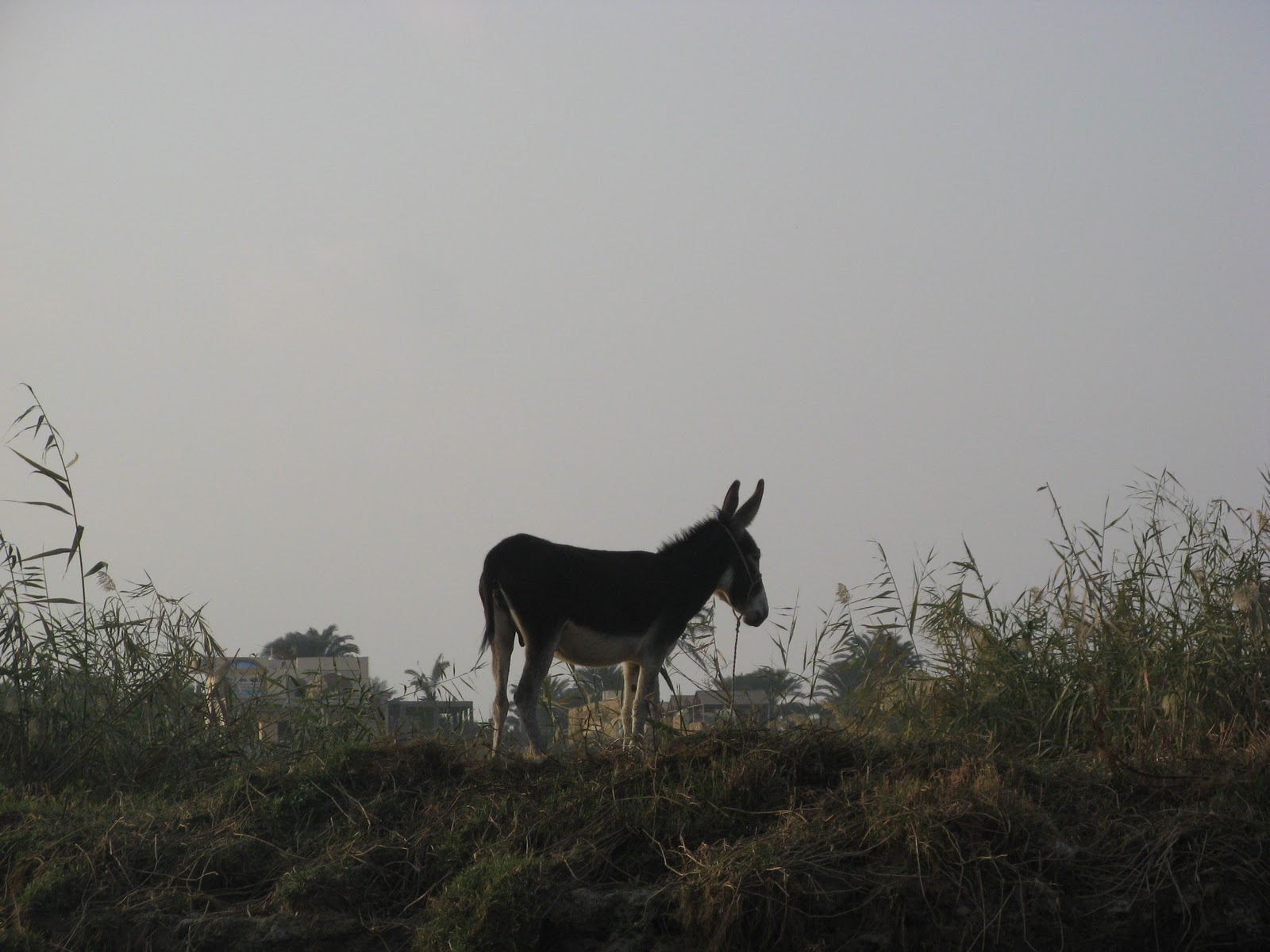
I see at least half dozen donkeys and a few horses, but mostly donkeys, for every car or truck on the road. They carry bundles on their backs, transport people and cluster in the shade of palm trees when not in use.

Small mud huts dot the landscape. I think these are shelters used when working a field and not permanent homes.

They are made from mud and straw bricks like those mentioned in biblical times. They look quite primitive, but no doubt a pleasant respite from the glaring sun. I’m enjoying my train ride so much. It’s like a living museum where life goes on from one generation to the next and change is measured in the millennium.

I start thinking about the two natural phenomena which dominate the landscape - the sun and the Nile water. No modern tourist can visit Egypt without awareness of the bright glaring ever-present sun. It rises in the east and falls in the west only to repeat itself every day. Likewise, the life-giving water of the Nile clearly transforms the dead desert into a living lushness.

It’s a small wonder that these natural phenomena influenced thought and religious development from earliest time. The sun evoked a god called Re, Atum, Horus and a host of other names as one aspect or another is emphasized. He becomes the king of gods.

The Nile becomes the domain of Osiris. His mythology follows the regeneration of life upon the desolate earth after flooding. He becomes identified with death, resurrection and the after-life. To learn more about the Osiris mythology and its interaction with the sun god mythology, go to http://www.touregypt.net/osiriscu.htm I think we still have shadowy remnants of these ideas when we look to the heavens for God and celebrate rebirth every spring.

Now I'm across the street from the Luxor Temple in a bookstore. As serendipity would have it, I find a most interesting book. It's entitled Development of Religion and Thought in Ancient Egypt and is written by James Breasted , an esteemed Egyptologist.

The Great Pyramids of Gizeh were built from 2575 to 2150 BCE and stretch some 60 miles along the edge of the desert. They represent an incredible effort of an entire society through purely material means "to immortalize the king's physical body, enveloping it in a vast and impenetrable husk of masonry, there to preserve forever all that linked the spirit of the king to material life." (Breasted, p 178) I use to think of the Pyramids as a monument commemorating a Pharaoh when actually they are a material place for immortality.

After about 2100 BCE, Pyramids were no longer built and after another 1000 years, they were mostly forsaken, left desolate amidst the shifting sands of time. An age of political disintegration took hold of Egypt. Mournfully, they began to realize the futility of massive masonry to insure immortality.  Skepticism ensued and with it, new ideas took root.

The afterlife which had been the sole domain of Pharaoh was democratized to nobles and eventually common people. Osiris and the sun god were redacted into a blended, if not always consistent, theology. By 1300 BCE a new religious order worshipping the sun god Atum was established. Thebes or modern day Luxor was at its center.
Now I am here.

As I stand among colonnades of Luxor Temple or visit Karnak Temple or wander the Valley of the Kings, I feel linked with these places. I realize that the development of human thought once moved through here and now moves through my generations and one day will move into places not yet imagined.

Later that night, we join a group for an evening of star gazing under the desert sky. Climbing a sand dune, we watch the sun go down or is it dying in the west. I now understand how natural phenomena can be given mythological meaning.

We gather around tables to enjoy a delicious Egyptian meal with people from South Africa, France, Holland, England and our Egyptian hosts. We are a diverse human family and yet we come together under the stars.

We are shown the Milky Way, constellations and star clusters. One star, Aldebaran, or the Bull`s eye, is said to be 65 light years away. I gasp, “Yikes, this one started its light path to earth during the year of my birth.”


Of course, other stars are much further away. They say our galaxy is about 120,000 light years in diameter and it is one among billions of other known galaxies.

Gazing into the heavens puts perspective on my Egyptian trip. As ancient as Egypt is, it is but a recent moment in the life of the universe. We are just beginning to send our light to distant places.

Like ancient Egyptians before me, I look up at the colonnade and the stars and I can't help but wonder. What meaning? What stories are yet to be told? What will human life and thought and religion look like in another 5000 years and beyond?

Tuesday, January 11

Egypt: Part II


Today is museum day. We are off to the the Egyptian Museum which is just across the street from our hostel. It was built at the turn of the 19th century and some have called it the "Warehouse of Antiquity" since it crams a lot of artifacts into its two floors without the more modern presentations.


I am eager to see for myself. After a day of surveying the Pyramids, I want to see what the Pharaohs took into the afterlife.


Fran and I queue-up in, not one but two, security lines. I am told later that Egypt has a number of make-work redundancies to keep people employed. We are thoroughly scanned and bags are properly searched.

Cameras are not allowed inside and must be checked. It's interesting to see the big tours companies filling baskets with their clients' cameras - thousands of dollars of digital hardware placed on a shelf with a coat-check token as collateral.


Internet photos from open sources

Inside a grand hall greets me. Colossal statues of Pharaohs beckon me onward. Smaller sculptures and bas-reliefs are displayed along the way. I am introduced to my first hieroglyphics close up.


Thanks to my niece Jenny's Christmas gift, I take out my new sketch pad and pencils and begin to draw what was chiseled into stone 4000 or more years ago.


I learn that ancient Egyptians were more pictorial in their thinking. They did not see the world in abstractions. My sketches show birds and snakes and implements of everyday life. Their writing tells stories in pictures. I become totally absorbed. What a grand way to visit a museum - sketch it!


Of course no visit to the Egyptian Museum would be complete without a visit to King Tut. Tucked in the back on the second floor with no signs announcing the way is his room.

King Tutankhamun means "Living Image of Amun." Here is a hieroglyphic rendering...
G39N5
Hiero Ca1.svg
imn
n
tG43tS34HqAiwnSma
Hiero Ca2.svg

He lived during the 18th Dynasty of ancient Egypt and only reigned for 10 years - 1333 BC to 1323 BC. He took the throne at age 9 and was dead by his 19th year. There's been a lot of speculation about his early death. Some say murder while others point to malaria, infections and various birth defects due to inbreeding that was commonly practiced among royalty.


King Tut has become widely popular since his tomb is one of the few that was not looted in antiquity. When Howard Carter, the famous archeologist, unearthed it in 1922, the gold face mask became an instant symbol of the Pyramids although he actually was buried a millennium after the Pyramids were built and in the Valley of the Kings about 450 miles away near Luxor.


I am captivated by this sarcophagus. It's an impressive piece of artistic craftsmanship. Every centimeter of the gold overlay is inscribed with a small delicate design. I just kept wondering how someone could inscribe the gold with such beautiful precision and I wondered what happened when a mistake was made?

Tutankhamum Scarab

I become bolder in my observations and try sketching profiles of statutes. As I am working, a guard comes by and says "nice" in English. He stands watching me. I smile with a little self-consciousness.

Just then, a young fellow stops and introduces himself. His name is Omar. He's an art teacher and artist himself. Today, he has a few students at the Museum sketching.

We enter into a wide ranging discussion of art and music and our various cultures. Besides being an artist, he also is a heavy metal rocker. He explains his kind of music is underground in Egypt. We both like Reggae because of its rhythm and social justice themes. I tell him about Zydeco from the Cajuns of New Orleans. We exchange emails and vow to stay in touch. And we do!!

He is the first Egyptian I have met who is not trying to sell me something. In fact he gives me one of his pencils as a token of friendship. Art is wonderful. It brings cultures together.

I feel like I crammed a lot into my 7 hours at the Museum. My mind is now a warehouse of images brimming over with ideas for art projects.

I retrieve my camera and look around outside. I take a few of my own photos before heading back across the street to the hostel. Omar has given me a suggestion for a cafe. Fran and I will give it a try tonight and compare notes about our day at the Museum.

Sunday, January 9

Egypt: Part I

Without thinking, we step on to a moving sidewalk at the Istanbul airport. I am with Fran, my Peace Corps travel buddy. We have a 5 hour layover before proceeding to Cairo Egypt. So engrossed in conversation, we don’t notice the end of the walkway approaching. Suddenly we spill across the floor. Hand luggage scatters along with our legs and arms.

What happened? Quickly we check for broken bones and scurry out of the way before more people tumble upon us. We are okay with more bruised egos than anything else. We look at each other and think, “How could we be so stupid?” Then uncontrollably, we begin laughing and laughing and laughing.


This incident becomes a metaphor for my trip. Egypt is all about shock and awe. I find myself in places I never thought possible. I experience the intensity and chaos of Cairo and then step into the stately antiquity of the Pyramids. I consciously try to learn to let go of control and just savor the experiences – good, bad or indifferent. It's about enjoying the ride for as long as I can and remembering to jump and not fall off the end.


Cairo is a densely compacted city of 7.8 million with as many as 10 million more people living in close proximity. Intense is an understatement.

Cars whiz along as if trying out for the Indy 500. Three lanes become 4 and sometimes 5 as cars swerve to gain an advantage of a few feet. I’m in the front seat and have to close my eyes more than a few times. Amazingly, I never see an accident although I certainly think one is about to happen. It’s as if cars become an extension of the people driving and they can calibrate the closeness to another within fractions. It’s uncanny.

Car horns beep and blare…constantly. It’s like they are talking to each other. Some taxis have special beepers. They emit a rapid high pitch and crescendo before ebbing in a wave of sound. The cacophony assaults the senses. I think maybe Cairo Egypt is where John Cage got his inspiration for his compositions of sound effects.
I try to cross the intersection to get to the Egyptian Museum which is directly across the street from our hostel. I walk a half a block to a traffic light, but quickly realize that lights are more ornamentation than traffic control. Egyptian drivers ignore them…yikes!

How to get across? At 9:30 am there is no break in the traffic and like I say, traffic lights don’t help. I watch other pedestrians. How do they do it? They boldly walk out in front of the speeding traffic. Of course, car horns blare, “Get out of the way.” The pedestrians extend an arm in a stop motion and then dodge between on-coming traffic. It’s magical. Cars mostly slow down.

I pick out a cluster of Egyptian pedestrians and decide to follow closely. Even though my blood pressure probably shoots up 30 points, I make it. I’m alive. By the end of the trip, I am doing it on-my-own. I just extend my arm in a stop motion and magically cross to the other side. Egypt is Pyramids and the Pyramids are everything you can imagine. However, getting to them is a challenge. We buy a tour from our hostel. It's a mistake. Our “English Speaking” driver has a limited vocabulary - very limited. Try as we do, there is no way to communicate. I now know the frustration my Ukrainian friends feel when they try to communicate with my limited Russian.
Our driver gets us to the Pyramids and then the tourist hustle begins. Everyone seems to have a scheme to help me spend money. It can be the shopkeeper who prices bottled water at 10 Egyptian Pounds when the local rate is 4 EP or it can be the dozens of long robed men trying to grab my attention with a deal not to be missed.

“Come with me....what is your name? This way please....where are you from? I have very good price. What you want…camel…horse…carriage? I get it for you,” they say. I feel like I’m being picked apart by the constant barrage of offers. I’m exhausted going a few hundred feet. It’s a hectic touristy craziness.

I fend off offers…although I am tempted a few times. I’m still a neophyte in the Egyptian bartering system. I don’t know a fair price and I don’t know what may lie ahead. Fran says she yearns for a shop with price tags. We buy tickets to get into the Pyramid area. At 60 EP (less than 12 USD) it's a deal and maybe the only one we will encounter today.

Spinx stands guard

After going through a security scan, AD picks us up right out of the crowd. He is 61 and soft spoken. At first I think he is checking our tickets and then I think he is a part of our entrance fee. Silly me. He explains that he is not trying to sell us anything. Huge relief.

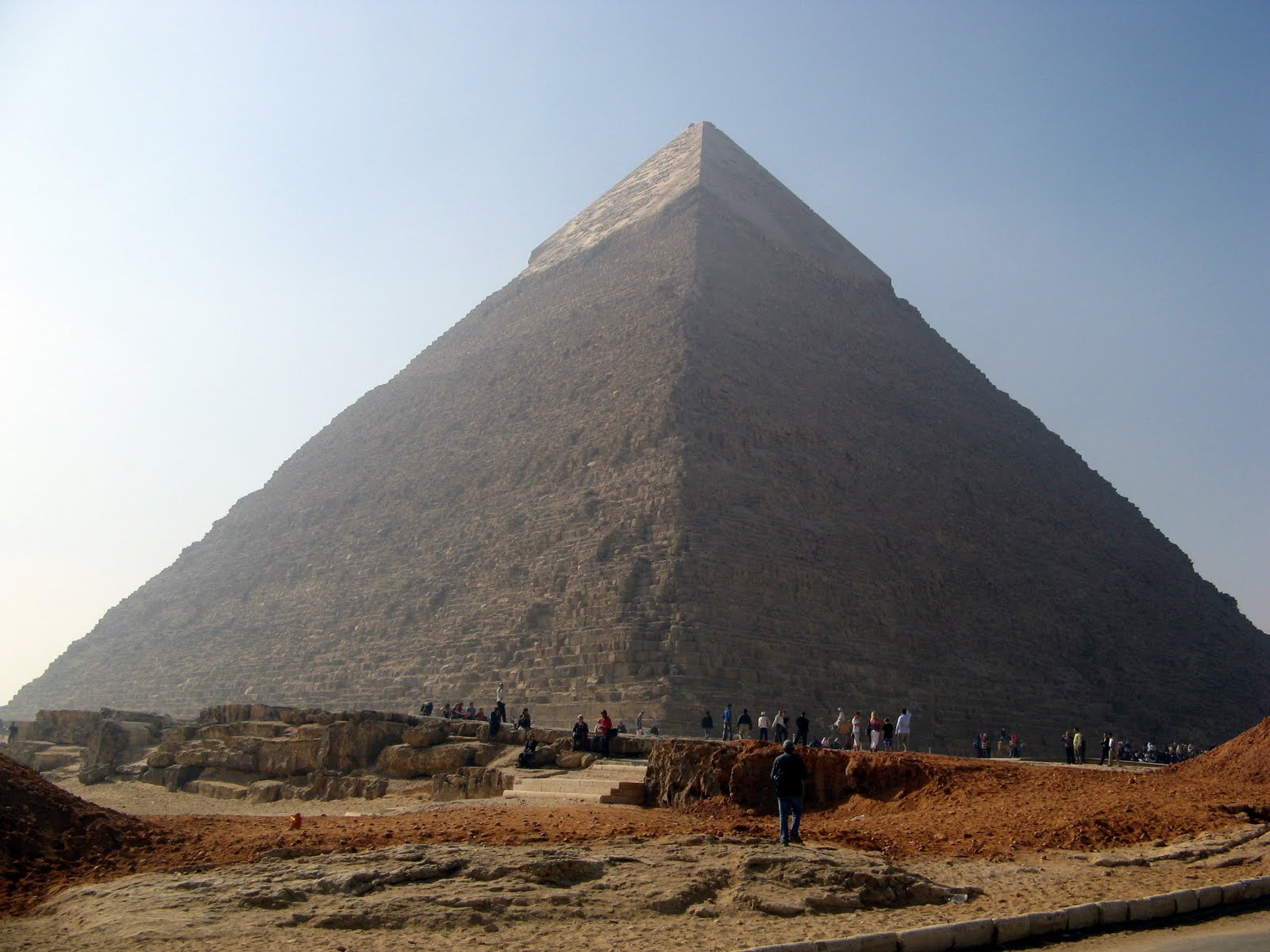
For about an hour he escorts us around the Pyramids. It’s a sunny day with a touch of dusty grayness or is it pollution hanging in the air? I feel like I have walked into a National Geographic layout. All my life I have seen pictures and now I am here gazing at mortuary monuments from Egypt’s Old Kingdom, some 4500 years ago.

The Giza complex includes three large Pyramids for the afterlife of the Pharaohs and three smaller ones for wives. A mortuary temple and complex is attached so that offerings can be made to the god-king and his resurrected life secured for perpetuity.. A causeway has been discovered that connects the colossal monuments and smaller tombs for nobles of the Pharaoh’s Court.
The volume of the largest Pyramid of Cheops is roughly 2,500,000 cubic meters. Based on these estimates and building over a 20 year period, workers (or were they slaves) would have installed about 800 tons of stone every day. Similarly, it means that of the 2.3 million blocks of stone, about 12 would have to be put into place every hour of every day for twenty years.

To learn even more go to http://en.wikipedia.org/wiki/Great_Pyramid_of_Giza

The Pyramid area is so vast that even with many tourists, moments of calm reflection are possible. I realize that here ancient people have made an insistent and passionate protest against death.


The Pyramids are an affirmation to life and a supreme revolt against the darkness and silence from which no one returns. They evoke mystery and deep soulful thinking.AD brings me back to the present as he finally makes his pitch for a “tip.” I give him 100 EP and feel satisfied that he is getting a fair compensation and I have not been taken too badly. After all, I reflect, “In the face of 4500 years of antiquity what difference does $20 dollars make?" I smile to myself, "There are better things to occupy the mind - life and death and beyond the horizon.”

Tuesday, December 21

Snap-Shots From Konotop

To take a good snap-shot requires the right equipment at the right time in the right place. I offer you two snap-shots from Konotop that prove the wisdom of being present in the moment.

Fridays mean Art Day at Hearts of Love Center. Just about every Friday I do some sort of Art Project with the children. It’s become popular to draw or paint with the American.

On some Fridays, I’ve seen as many as 18 kids in space for maybe 10. I do get a little tense and overwhelmed, but with the help of Annya, I keep my cool. She says with a smile, “Normalna. It’s normal.”

Last week, I made a huge Christmas tree by taping together blocks of paper and using my watercolors to paint the branches. Then the children drew ornaments to decorate. All levels and ages contributed. Some of the ornaments are decorated ala scribbles while others are carefully drawn. One medicated boy surprises me. Instead of the usual scribbles, he draws a design for the first time. I say in my best Russian, “Good job…Good Job.”

I always insist that the children put their names on the art. I think by claiming it as their own, a little piece of self-esteem is added to their lives. Often they will take the art to other adults at the Center and bask in the approval.

I am putting away supplies and getting ready to go home, when a little girl bursts into the room. “Chi, Chi, Chi,” she insists. I make my way down the hall to another room where she and a friend are setting the table with china cups and plates – no Styrofoam here.

Then I learn it’s the little girl’s Birthday. She is a 8 years old. Her mother has brought in a small cake for a small celebration. It’s a special treat.

As we settle into our places at the table, we are invited to share a Birthday wish. This is a wonderful Ukrainian ritual. People talk intimately about a person’s character and offer wishes for a good life. Each wish can go on for several minutes. I love the way Ukrainians are not embarrassed to express kindness.

I look at the little girl. She is wearing a red dress. Red is considered most beautiful for Ukrainian women. And this little girl is beautiful in her own special way.
What I notice most is her demeanor. She glows with Bambi eyes wide open. The gentle words of praise accumulate like dozens of presents – but only more valuable. I am touched when her older brother speaks in admiring terms of love. We all should be so blessed.

I place my hand on my heart and take a mental snap-shot.


<<<<< >>>>>

Whether it's Santa or St. Nicholas, there's magic in the idea that a stranger will come to give gifts. Sometimes it’s expected and other times it happens as a surprise.

At Hearts of Love, the hallways are strung with tinselly garlands. We are having a lot of fun getting ready for our St. Nicholas party. Just when I think all has been done, Yelena finds another box of tinsel. More is better. I tease her that she's decorating this center like a mother with a gang of kids.

My watercolor tree is decorated. The children have covered it with their own creations. I am proud of them. Festive bags have been bought and filled with candies. We are expecting about 35 children.


The party unfolds as expected. A play is performed by an acting troupe from our House of Culture (a Soviet institution that continues).


The story pits a fox and wolf against two little hares with a big old bear as referee. There are chase scenes, deceptions, fisticuffs and more. But in the end all are friends. Ukrainians like animal stories and judging the reaction from the children, they love this one.

Finally St. Nicholas comes. Instead of red and jolly, he is dressed in a light blue cloak and a monk's hat. He gives a little blessing and then distributes bags of goodies.
A large gingerbread man has been added – compliments of our new Mayor. The children are delighted. A few games are played and then the party ends. Thank you, St. Nicholas.

I am putting on my coat when I learn that the Vice Mayor of Konotop has dropped by and wants to meet me. With the election of last fall, governmental leaders have changed and the new Mayor is reaching out.

After introductions, the Vice Mayor gets right down to business. "How does this organization compare to ones in America," he asks? “Wow,” I think. “How am I going to respond to such a question?”

I have learned during my time here that Ukrainians will sometimes ask the comparison question as a way to determine if we are with them and find them acceptable. I quickly re-frame the question into a litany of what Hearts of Love is doing well - like transforming a crumbling building into a center of life and activity, a place where children who might be ignored are considered special.

I talk about the challenge of funding and the need for local support. I offer the idea of a "United Way" approach. He leans forward. He’s interested and asks, “Will you come and meet with the Mayor?”

I’m totally surprised. What an unexpected opportunity!

Then he turns to Yelena and says, “I think we should make a professional video so that the people of Konotop can learn about your work here. “ It’s another unexpected surprise. The meeting ends with exchanges of emails and wishes for a Happy New Year.

Later as I am getting ready to leave, Yelena turns to me, “You told us to widen our circle of friends…You know, we listened….See what’s happening.”

I put on my jacket, smile and take another mental snap-shot.