Translate

The content and opinions expressed in this blog are mine. They do not represent the US Government or US Peace Corps - Jud Dolphin

Tuesday, March 29

желмасив - My Living Place

My apartment is in the neighborhood of желмасив.  To pronounce it, say zhelmasiv.  Roughly translated, it means a place for living.  When I tell Ukrainian friends where I’m living, they smile and joke, “You’re in Siberia.  It’s so far away.”  Well maybe, but I call it home even if it’s next to nowhere.

Let’s travel to my Ukrainian home in желмасив.  See the sights that have been part of my life for nearly two years.

We’ll start in the Center of Konotop near the cinema and the town’s main fountain.  Neither works. 

The movie theater has been closed for years.  People say that DVDs did away with the need.  In my opinion, it’s a pity.  Teenagers still gather in front when day-light turns to twilight.  They promenade in an ageless ritual of looking and being seen. 

The fountain only works on special holidays and sometimes not even then.  But the children love the fountain or more correctly, they love the child-high wall that encircles the fountain.  


They place tiny hands on the concrete surface as if by touching they will have power.  And they do.  Little boys clutch toy cars and trucks as they speed around.  Little girls giggle and race around too sometimes beating the boys. 

Occasionally, a few older children dare to mount the wall and slowly walk the concrete strip like a circus performer.  So proud they become.  To walk around the wall is an accomplishment for a 4 ½ year old and making it all the way is a relief for nervous parents who hover nearby.
  
I love this fountain without water.  I will sit and watch the drama unfold for hours.  Who needs TV when real Ukrainian life is right here?  But today we are going to the edge of the city...to желмасив.

We’ll catch either a van or a mini-bus.  Both cost 1 ½ UAH (12 cents), but vans are smaller.   In a van, you have to crouch down low as you enter so as not to hit your head.  Then you must navigate up two steps while trying to swing the door shut.  


The steps are narrow and if you are not careful and if your feet are big, like mine, you will trap your shoe between the door and the riser of the step.  Believe me, I have learned the hard way.  That’s why I prefer the big yellow mini-buses. 

Of course we could hop on the trolley.  It goes to желмасив too.  Since Stalin’s time, Konotop has had a trolley or tram way system.  It opened on Christmas day in 1949 and runs for about 15 miles (24 kilometers).  Seniors get to ride free.  You are supposed to get an official stamped card, but I never have.  I guess I just look the part. 

Down the main street of Konotop, we go.  It is one of the main arteries that are paved.  Like many towns in Ukraine, this main street is named Перспектива мира.  To pronounce it, say Perspektiva Mira.  Prospect Peace.

Out our left window is the park.  A statue of Lenin waves in front of the City Building and a Shevchenko statue reclines while reading poetry across from the Post Office.  


Benches line the walkways.  A few kiddy rides are further back and mostly in disrepair.  The Soviet State use to provide family fun in the park, but of course, it is no more.  Private enterprise has yet to fill the gap. 

On our right is a row of магазины.  To pronounce it, say Magazeneh.  Stores.    A few Babushkas huddle in front selling pussy willows and sunflower seeds. 

Pussy willows are signs of spring and the approach of Palm Sunday.  Since there are no palm trees in Ukraine and other trees do not leaf early due to the harshness of the climate, only pussy willows reveal their tender catkins. 


Leaves are present too, but not quite visible – a symbol of Easter joy that remains hidden, but soon will be revealed to the faithful.  Everyone wants to have a bundle of pussy willows in their home at this time of year. They have a story to tell.

See the three guys standing on the corner.  Notice that one shares a handful of sunflower seeds with the others.  It’s a popular snack and maybe a national pass-time. 

In a smooth motion from hand to mouth, they crack the seeds between their front teeth extracting the kernel and spitting out the husk while not missing a word of the conversation.  It’s multi-snacking at its best.    

We make the turn at фора (Phora).  It’s one of Konotop’s supermarkets. Between the Bazaar and here, I purchase most of my food.  It’s not huge like an American Shop-n-Save.  It’s more like a convenience store on steroids.

Inside you can find most of what you need.  It helps to be able to read Russian, but then sometimes it gets confusing.  Well, a lot of the time, it gets confusing especially when the labels switch to Ukrainian.  


I guess that’s why it’s a relief to come down the vodka, cognac, beer aisle.  Everything is color coded - white for vodka, brown for cognac, and skinny neck bottles for beer.       

On our mini-bus, we pass by “Little Palestine.”  During our last walk, Gregory pointed it out to me.  “It’s where Konotop’s Jewish families lived before famine, wars and Nazis.”  


He showed me his boyhood home which is now an office.  He lived in a room about 12 x 15 with no kitchen or bath.  Both were down the hallway and shared with other families.  This was known as family dormitory living.  I do not recommend it.  I almost never pass by without saying a blessing for Gregory.  If it matters in heaven, Gregory is remembered. 

Our 15 minute ride is not so far by American standards.  I know people in Boston who commute more than an hour.  But still I am on the edge of city development.  It’s the end of the line for the mini-bus, van and trolley.  All three will turn-a-round here. 

We get off and see an open field across the way.  The soil is dark black and is said to be among the most fertile in the world.  Individual plots have been laid out.  In a few weeks, families will be out there turning the good earth by hand and planting food for the next year. 

It’s a necessity.  I have learned that Ukraine’s minimum monthly pension is 596 UAH ($73) and its average is no more than about 1,060 UAH ($130).  It’s a pittance for a life time of work, but even at these levels, officials say the entire pension system is in dire crisis.

I’ve seen the alternative.  An elderly woman scavengers through the trash containers not far from my home.   She searches for any item that can be sold.  And as difficult as it is to realize, she will also grab anything that can be eaten. 

Stray dogs stand patiently in the shadows of the dumpsters, like sentinels, watching for any scrap that may be tossed their way.  Other people scurry here and there and seem not to notice much.  Очень жаль.  To pronounce, say ochen zhal   It’s a pity.

We walk another 15 minutes to my home.  We pass a gaggle of Soviet apartments. They are five stories high and either of concrete or brick construction.  To be higher would have required elevators according to Soviet code. 

Balconies protrude in vertical rows.  Each hangs in various states of repair.  The overall appearance is disjointed and drab.  In Soviet times, these buildings served a utilitarian purpose – to get families out of dormitories and into a home of their own.  That part worked.

We notice in the distance some new construction.  Locals call it “poor street” with obvious sarcasm and maybe some envy.  Apparently free enterprise has given some people more – a lot more.  And they have constructed their own castles on the edge of желмасив,  on the edge of town.

My place is modest – ever so modest.  I have one main room that’s about 12 x 10 feet.  Here is where I sleep and read and write this blog.  My desk occupies one corner and my armoire sits in  the other.  A fold-down futon takes up most of the other space. 

A short hallway connects this room with my bathroom.  Last September, I got hot water.  I’m in favor of hot water.  But even when I was without it for 15 months, I adapted and I think most people would. 

Next to my bathroom is a kitchen.  I have about a foot of counter space.  Whenever I am with other volunteers, I always make a complaint.  With tongue- in-cheek, I gleefully rant on.  It’s become my signature joke – a gourmet cook with so many ideas and so little space.  Chuckle, chuckle, chuckle…
    
And whenever I’m invited to another volunteer’s apartment, I stand and envy their two feet of counter space.  It’s all in fun because I know many Ukrainians prepare elaborate meals for people they love with no more than I have.  They prove that you can do a lot more with less. 
  
 I’m thinking people adapt.  We adapt to more maybe too easily and we adapt to less maybe without realizing it.   We may not like it.  We can complain.  We can have fear or envy.  But in the end we adapt and it’s a good thing.


So Welcome, my friend.  I live on the edge of town in желмасив.  Even though it is not a "poor street," I like it.  It's become my living place.  

Sunday, March 6

Peace Corps Birthday Gift

Fifty years ago this month, newly inaugurated President Kennedy established the Peace Corps.  Over the years, more than 200,000 volunteers have served in 139 countries.  Back then as today, Peace Corps Volunteers shared skills and knowledge, represented America to host country friends and brought cross-cultural understanding back home. 


Happy Birthday, Peace Corps.

What would a birthday be without presents?  In Konotop, we took this occasion to open the world of English literature to an entire community and in so doing created a legacy of knowledge and cross-cultural understanding.   

Where none existed before, more than 300 English literature books are given and made available to everyone.  This English literature library was made possible with gifts from Americans to the Peace Corps Partnership Program and with additional gifts from the personal reading shelves of Peace Corps Volunteers serving here in Ukraine. 

What a great way to honor the Peace Corps. After all, for 50 years the Peace Corps has been about giving in country after country around the world.

My team - Tatyanna, Irena, Anna
“We are making history,” whispers Tatyana with eyes glistening.  She and Irena and Anna are English teachers at the Poly-Technical School and Institute in Konotop.  For more than 6 months, they have planned and worked for this moment.

“Remember you came to us on September 10th with this idea of English literature,” recalls Anna.  “We wanted more text books at the time, but you introduced the idea of literature.  We did not know it, but our Head-Mistress also had a dream of offering English Literature to our students. “   

The Head Mistress had participated in a cross-cultural exchange program and spent a month in Ames, Iowa.  She brought back many new ideas.  Wonderfully, the synergy of the Peace Corps, an idea brought from the heartland of America and gifts of books will now make dreams come true.
PC Director, Douglas Teschner,  with PC Volunteers, Rose Cheyette, John VanGavree, Dan Cahoon, Danny Zawacki, Kim Rosado, Jud Dolphin with Gifts of Books

I am with Douglas Teschner, our Peace Corps Ukraine Director and an entourage of local Peace Corps Volunteers.  We are walking down the hallway towards the library.  Along the way students direct us.  They are dressed –up for the occasion.  Suits, formal dresses and an occasional thumbs-up greet us.  It’s obvious that today is considered a very special one. 
   
As we enter the Library, the Head Librarian and her staff are all smiles.  When we first met, I remember her showing me a handful of Soviet English publications from the 1960s.  That plus a few other books at the city library were the extent of English literature in Konotop.  None of the classics were available.

“We may get as many as 300 books and each one will need to be catalogued. It’s a lot of extra work,”  I caution.  Earlier in the month, I had been turned down by the City Library so I wanted to check out interest.  But this librarian is more excited than worried.  She assures me, “Not a problem.”   Weeks later, Tatyanna glows when telling me that the library staff is learning English too since each title must be translated and entered into the computer.

It seems to me that giving creates its own rippling effect.  It keeps expanding outward creating waves of possibility where none existed before.   As Douglas remarks, “The books are important, but it’s not just about the books.”

With obvious pleasure, the Head Librarian now displays shelves of English books.  Each has been prepared properly - a translated routing card and a stamp that says US Peace Corps Partnership Program.   The books include many abridged versions of classics so that even beginners can have a positive reading experience.  Other books are full versions for those more advanced. 

Anna and Tatyana 
I remember going to Kiev with Anna and Tatyana to buy the books.  We started before dawn on a cold dreary day.  First I had to go and get cash.  Ukraine is mostly a cash economy.  Few shops take credit cards.  For a time I was a rich man with over 12,000 UAH ($1500).

We invaded English only shops and outdoor stalls.  Previously at their own expense, Tatyanna and Anna had checked-out possibilities in Kiev and knew exactly where to go.  Carefully, we selected titles.  So absorbed we became that we forgot about lunch until 5:00 pm.

Getting the books back to Konotop could have been a problem, but as a sign of the School’s commitment, the Head-Mistress provided a car and driver.  Perfect.  Since then, we felt that problems could be solved. 


It’s an important lesson for everyone to learn and here in Konotop, we replace problems with a good feeling.  I don't know who started it, but whenever we come across a problem, we remind one another of the Bobby McFerrin tune and hum - “Don’t worry…Be happy”    http://www.youtube.com/watch?v=d-diB65scQU

Now anyone in Konotop can check out a book by showing identification.  Young or old, student or not, all are welcome.  It’s a huge change in policy and one that might challenge even American colleges.

Two young Ukrainians in traditional dress hold a red ribbon in front of the bookshelves.  As the Head-Mistress and Douglas cut it, I can’t help thinking that here cultures are meeting and embracing one another.    Soon an English literature course will be part of the curriculum.  Tatyanna boasts, “Some of the students have already checked out books.”  


A piece of the ribbon is handed to me.  Waving it in the air, I am ecstatic
. 
Inside the Reading Hall, a crowd is gathering.  As I walk to the front, I suddenly notice two very special people.  Gregory’s widow and daughter are here. 

You may recall that when my first organizing attempts were rebuffed by the city library, Gregory told me that “something good would happen.”   Sadly he died before he could see his prophesy fulfilled.  I embrace his widow and daughter and my eyes well-up with tears.  They are strange tears, but mostly ones of joy, inspiration and gratitude. 

Two students emcee our program.  We are treated to a wonderful full-length Ukrainian ceremony.  We hear about the dawn of writing and scrolls and papyrus and eventually the printing press and books as we know them.  Two charming poems are recited in English and a few songs are mixed in along with a stand-out performance on the Bandura.  Please learn more about this traditional instrument.
  

Douglas and I both are invited to share a few words.  The people are impressed with Douglas and more than one remark how wonderful it is that he comes all the way from Kiev.  He talks about the Peace Corps, its history and its enduring goals.  He tells everyone that the Peace Corps is now 50 years old. 

It’s a perfect segue.  Each of my Peace Corps colleagues brings a gift of books from their own collection. Festooned with ribbons and bows, the books pile up as a tribute to the Peace Corps and a symbol of our friendship with Ukrainian people.
   
I say, “We give you the enjoyment of books.  We give you the knowledge of books.  We give you improvement of English through reading books.  We give you your dreams with books.  We give you understanding of other cultures.”   And then I add, “We give you our friendship and hope for a very good life.”

After all the speeches are completed and people filter out, two young boys stop to speak with me.  Their English is pretty good and they bubble enthusiasm.  Each pledges to read many of the new English books.  I smile and think maybe they will….so many more possibilities exist now. 

Happy Birthday, Peace Corps.

Monday, February 28

A Toast for Civil Society

"Let me say a few words...a toast to so many walls falling down...no longer afraid...we are open and can talk our minds...friends without fear and barriers," smiles Natalia, the Director of the Institute of Leadership and Management of the Ukrainian Catholic University.

I am with her and two of her team members relaxing over dinner after a long day that included my seminar on Practical Public Relations for NGOs (Non-Profits).

Her toast comes after an extended conversation about struggles for a civil society and lingering consequences of Soviet rule. Although it's been 20 years, I am continually struck by the dark depth of this legacy. It seems like Soviets in an effort to control human thinking left deep scares marked by fear and isolation.

(Courtesy of Suzanne Cochran, Peace Corps Volunteer)
"As children, my brother and I went to Holy Friday worship services with my mother," Natalia shares. "It was held at night because in the dark, it is not so easy to see who is going in and coming out."

She tells about a time when they were observed by authorities. The next day at school, she and her brother were taken into a room and reprimanded. "Good Soviet Pioneers (a Soviet children's program) do not go to bad places. Only bad people go to churches." As Natalia says, "We learned to stare a hole in the floor and never say a word."

The Soviet system imploded in 1991 and Ukraine rose up declaring its independence. The world would need to learn that this land was no longer "The Ukraine" as if it was a section of a larger country, but simply Ukraine, a fully autonomous nation.

I remember having to learn to drop the article "the" when I first came to Ukraine. The Soviet legacy was a part of my mind too. It may seem like a simple or even silly grammatical change, but it is more. It is about identity, human dignity, freedom and hope for a better life.

I am in the west of Ukraine in the city of Lviv. It's a 13 hour train ride from Konotop and a mere 85 kilometers away from Poland. During much of Ukraine's history, the area around Lviv has been been annexed by one empire or another. Poles, Lithuanians, Astro-Hungarians, Germans and of course Russians took turns. Still through it all a remnant Ukrainian identity survived. And now since 1991, there is but one Ukraine from Lviv in the west to Kiev in the middle and Donestk in the east.

My seminar brings together about 30 NGO leaders. Each is engaged in some form of community service or charity work.

It's remarkable.

Back in Soviet times, there was no entrepreneurial leadership. If it was not done by the State, it was not needed. You did not embark on your own. To do so was to invite danger to yourself and your family. So many Ukrainians have told me that they got real good at being invisible and just blending in. 

It reminds me of the old Beatles tune - "He's a real nowhere Man, Sitting in his nowhere land, Making all his nowhere plans for nobody..."
So truly it is remarkable to see so many leaders eager to learn and increase the effectiveness of their NGOs. These men and women are building the structure for a more civil society. Association by association, network connection by network connection, the slow process of regaining a good life is happening.

A mother talks about her son with autism. "They told me he would be nothing and should be kept at home and out of sight." She rebelled, went to school to learn about treating autism and now heads a small organization that gives hope to other families.

A young fellow, maybe 28, is working to resurrect Ukrainian culture and teach the next generation about the traditional ways. He is planning a cultural festival in Spring and is eager to learn about press releases and press conferences and how to spin a story into news.

An older woman talks about uniting pensioners so that they can speak in one voice. Her organization is part social and part advocacy. Immediately I think of AARP and the similarities of how it got started. I share lots of ideas. She can't wait to check-out the AARP web site - http://www.aarp.org/

A woman tells about a mini-bus that travels the streets of Lviv giving HIV tests and AIDS information. "A lot of time people don't notice us," she laments. We discuss placing colorful circle and a banner on the bus so that it stands out. I suggest, "Maybe a radio station will play a game and ask listeners 'where in Lviv is the HIV bus today!'"

We have a lot of fun. Thanks to a wonderful translator, I can freely share practical ideas, antidotes and even a few jokes. We all have a laugh when I use a colloquial expression and my translator stares at me in disbelief. "What will he say next?"

Even though the Seminar goes on for more than 6 hours, most of the students stay. They are so eager to learn and grow their organizations. It's a delight to be with them.
It's like seeing a kind of transformation. Silent head-bowed obedience is being replaced with animation and tons of questions. The human spirit lives. Minds can think new ideas. People can associate in new ways. Civil Society emerges.

So, dear friend, I invite you to join us. Say a few words and offer a toast. Americans and Ukrainians, we are friends without fears or barriers. Let us help one another live into a good life.

Saturday, February 12

Egyptian Antiquity and Tahrir Square


More than 4000 years ago, a moral conscience developed among Egyptians.  I have been reading Development of Religion and Thought in Ancient Egypt by James Breasted.  

Absorbing the evolution of ancient thought as I watch 21st century history unfold in Tahrir Square has created a remarkable convergence of underlying truth.  I realize anew the depth and strength of the human spirit.  It cannot be denied. 

In this civilization along the Nile, people created a cradle for our civil society.  From prehistoric roots, they developed the first awareness that social behavior is linked to human development and the will of the gods.  Some experts say that their social consciousness was well established more than three centuries before the Ten Commandments.  

Even Pharaohs are subject to judgment.   Carved into the walls of their tombs are pleas of innocence.

“I did not slay men.  I did not steal from one crying for his possessions.  I did not take away food.  I did not diminish the grain measure.  I did not commit adultery.  I did not stir up fear.  I did not stir up strife.  I was not avarice.  I was not puffed up.  I did not make falsehoods in the place of truths.  I was not deaf to truthful words.  My heart coveted not.  I did not wax in hot temper.  I did not do an abomination of the gods.” (Adapted from Book of the Dead, translated J. Breasted, pp302-303)

Injustice does not stand.   As Martin Luther King said to a powerful country still needing to address its own injustice, “…the arc of the moral universe is long, but it bends toward justice."

Before January 25th and the start of the protests in Egypt, I was emailing Omar.  You may recall him as the artist I met in the Egyptian Museum, just a few blocks from Tahrir Square.  He was the one who recommended a cafe on Tahrir Square.

I did not know then that the cityscape I was exploring would soon be filled with tanks, military and millions of ordinary Egyptians fed up with the dictatorial system .   

Omar writes one week before the start of protests:

“the weather here is kinda cold, winter break just came by, my birthday in 2 weeks and my 6 months anniversary with my girlfriend, I am really excited about the 2nd one because I really think she is the one :)

I am starting my own company too; Vinyl designs - as in records not the material :D - , WISH US LUCK.  WE NEED IT!!!

best wishes from the ever green Egypt :)”

A very normal and friendly note from an almost 21 year old.  It’s what you would expect and then a few days later I receive this email:

“Hey Jud

how are u doing?  yea things have been crazy the past week! a lot of people escaped prisons and were stealing malls and homes.  i almost got shot like 6 times and i almost killed a man.  feels weird but thanks god me, my family and our home are unharmed.  the good thing is that people are uniting again, everyone cares about the other and our love to our country got restored.  pray for us.  btw i am 21 on the 7th :D”

I honor his request for prayer and celebrate his birthday by sending a home-made birthday card.  I write the following to him:

“I am very glad to hear from you.  It must be a very scary time but also a time for much needed change….

I can only imagine the fear of being shot at and the terrible feeling of almost shooting another.  I am glad you were spared that experience.  May it continue.

Are you sleeping on the square?  Are you protecting your area from criminals?  I of course will pray and trust that good outcomes will happen for you and your country. 

I will celebrate your 21st Birthday on Monday.”

I assume Omar celebrated his birthday on Monday, but did not hear from him.  Of course, I worried as the stalemate became more intense.  The news had a face and it was Omar's.  Then history was made on 2/11 and Omar wrote:

“YOU HAVE NO IDEA HOW HAPPY, ALIVE AND DIGNIFIED WE ARE AT THIS MOMENT  I CRIED OUT OF JOY! I COULDN'T BELIEVE IT!!!

it has been a long journey, I myself almost got ran over twice, almost got shot 8 times
and full of bruises and scars now.  i have lost friends and i ve seen bad things
but i gained freedom and got my country back :D”

Like all the commentators say, Egypt has so much to accomplish for freedom and justice to flourish.  But this is a land and people who first gave voice to our higher ideals.

Like a kind of unintended immortality, we have the words of justice inscribed on the walls of ancient tombs.  Even now they strengthen our human spirit.  I have a feeling that something good will emerge and I think my young artist friend will be a part of it. 

Omar, God bless you….

Civic Engagement and Service Learning

“Can you help us develop a grant for Civic Engagement,” comes the invitation from Tatyana, the Director of the Poly-Technical School?

Tatyana is a graduate of an American Exchange Program that took her and a few others from Konotop to Ames, Iowa.  Now there is an opportunity for a grant to further Civic Engagement locally.

I arrive for a meeting.  It’s a small world.  By coincidence, my brother and his wife lived in Ames for most of their married life.  Warren taught biology at the Iowa State University and Judy directed the campus YWCA.  They never met Tatyana, but amazingly they share friends in common.  Because of this Ames connection, I think Tatyana and I share a special friendship. 

Her request to help develop a grant comes unexpectedly.  Initially, I have no idea what to suggest.  I fret about it for a couple of days before the meeting.  I am honored to be asked and increasingly I’m afraid I have nothing to say. 
  
As a last gasp for something, I start looking at my Peace Corps Training Portfolio.  I’m looking for ideas, any ideas.  But there is nothing.  I sort through more files and dust off my assortment of how-to manuals.   I am getting desperate.

Suddenly, Service Learning jumps out at me.  In the first summer of my Peace Corps experience, I attended training about Service Learning.  


When I returned to Konotop, I tried to interest a few people, but it went nowhere.    I placed the how-to booklet behind my shoes in the bottom of my armoire.  It stayed there until today.

I quickly research the idea on the Internet and put together a one page fact sheet translated into Russian.  I put a call through to the Peace Corps Office and get them to send me all the materials they have on Service Learning.  Strikingly, they have been translated into Ukrainian.  I am soaring high.  Who would have thought that such a great idea would be lying dormant in my armoire?     
Briefly if you don’t already know, “Service-Learning is a teaching strategy that integrates meaningful community service with instruction and reflection to enrich the learning experience, teach civic responsibility, and strengthen communities. “   


(http://www.servicelearning.org/what-is-service-learning)
 I think it is a perfect  idea for Civic Engagement.  At our meeting Tatyana agrees.  She asks whether Service Learning is common.  I say, “It’s growing in America, but maybe not so much in Ukraine.”  She smiles and says, “Maybe we will be the first.” 
But there is more.  Tatyana goes on to explain that she is finishing her doctoral degree on educational pedagogy emphasizing engagement of students.  We both see a wonderful merging of her academic work with Service Learning and this grant opportunity.
Others are called into our meeting and soon assignments are made to develop the grant.  I will help with the English translation. 
I leave the meeting with a glow of satisfaction.  Sometimes all the pieces do fit together.  In another small way, the Peace Corps is making a difference in the world.  

Monday, January 31

Call for Compassion

It's strange to look at a CNN photo of the Egyptian Museum with fully armed tanks rolling down the street from the very spot I stood just a month ago.  Gone are the traffic jams replaced by armed power and fear.


I have no great insights about the whys and wherefores of yet another world conflict.  It just seems to me that the world churns onward with too many many reminders that we need more justice, understanding and compassion for the entire human family.  Maybe it sounds corny, but surely it's needed.

As chance would have it and while I am doing research on an upcoming seminar on marketing for NGOs,  I stumble upon a video and the Charter for Compassion.  www.charterforcompassion.org

"What's this," I say to myself?   With a click, I take a look.  It's a remarkable video and an inspiring message.  I think, "Maybe this message can infiltrate the human family in a new way and empower a little more justice, understanding and compassion.  So I will pass it along and who knows where and what it will do."

Sure it's not solving desperate problems and maybe it's a little corny, but with a little more justice and understanding and compassion....

Tuesday, January 18

Trains, Temples and Stars

Images of antiquity seem ubiquitous. They’re available in picture books or on our computers whenever we want them. Las Vegas gives us Pyramids and the Sphinx in miniature. It’s easy to think, “ We've seen that before,” and glibly move on.

But today, I’m surrounded by the real thing - a formal colonnade inside Luxor Temple. I’m impressed and stand in wonderment. I can only imagine the awe people felt 3500 years ago when they stood in the same place where I am standing now. They had no pictures, no miniatures and no buildings as tall as these towering structures. The sight must have shaped their thinking and conveyed a deeper meaning.

Fran and I travel to Luxor via a day train. We want to see the countryside and catch glimpses of ordinary life. The seats are comfortable and the windows are grimy giving my photos an antique look. The trip will take all day and then some. It’s about 450 miles following south along the Nile Valley.

Outside it’s lush green. The Nile through a series of canals certainly transforms the desert. It’s as if someone has drawn a dividing line - water and green vegetation on one side and dry desert on the other. It’s a remarkable to see how the Nile makes life possible.

Interestingly, the Aswan Damn, which is further up stream (south), now controls the periodic flooding. Water flow is carefully measured out. Peasants use gasoline powered pump to lift the water from canals. Their fields are laid out in 15’x20’ plots with raised walkways to contain the water. It creates a kind of green patchwork quilt.

Unfortunately, they no longer get the benefits of rich black soil that flooding had brought since the dawn of recorded time. Now they buy fertilizers from chemical companies.

I spy a family tending their field. They’re dressed traditionally like we use to imagine when we dressed up for the Christmas pageant. Long flowing robes called Gallibya cover from neck to ankles. A head wrap protects from the sun.

It’s a quaint picture for a westerner though I am sure it is anything but a quaint life. I know a little about rural life in Ukraine and this seems more severe.

I see no mechanization except the water pumps. The family works the field on their hands and knees. They are cutting what I believe is alfalfa. It's feed for their animals.

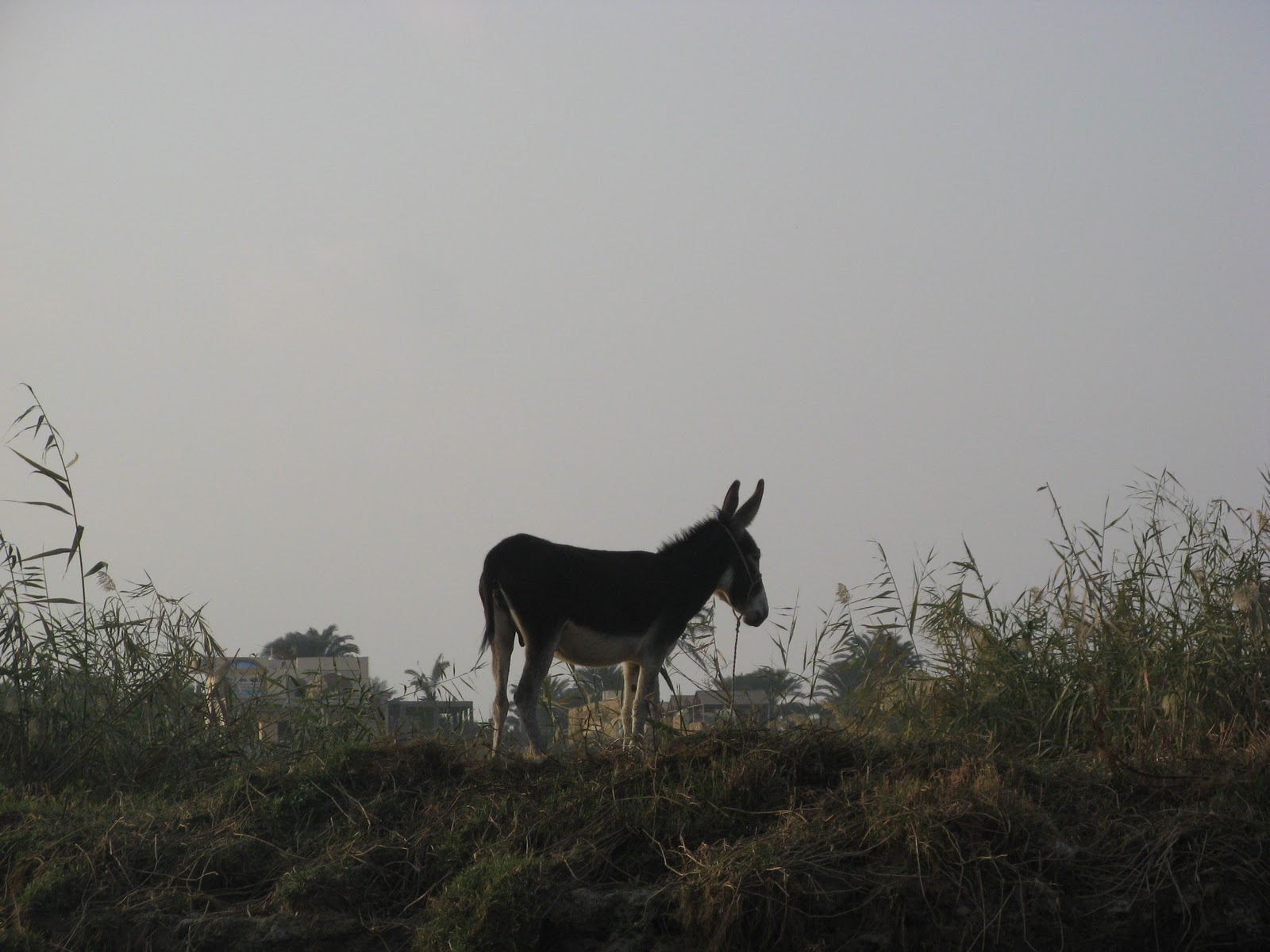
I see at least half dozen donkeys and a few horses, but mostly donkeys, for every car or truck on the road. They carry bundles on their backs, transport people and cluster in the shade of palm trees when not in use.

Small mud huts dot the landscape. I think these are shelters used when working a field and not permanent homes.

They are made from mud and straw bricks like those mentioned in biblical times. They look quite primitive, but no doubt a pleasant respite from the glaring sun. I’m enjoying my train ride so much. It’s like a living museum where life goes on from one generation to the next and change is measured in the millennium.

I start thinking about the two natural phenomena which dominate the landscape - the sun and the Nile water. No modern tourist can visit Egypt without awareness of the bright glaring ever-present sun. It rises in the east and falls in the west only to repeat itself every day. Likewise, the life-giving water of the Nile clearly transforms the dead desert into a living lushness.

It’s a small wonder that these natural phenomena influenced thought and religious development from earliest time. The sun evoked a god called Re, Atum, Horus and a host of other names as one aspect or another is emphasized. He becomes the king of gods.

The Nile becomes the domain of Osiris. His mythology follows the regeneration of life upon the desolate earth after flooding. He becomes identified with death, resurrection and the after-life. To learn more about the Osiris mythology and its interaction with the sun god mythology, go to http://www.touregypt.net/osiriscu.htm I think we still have shadowy remnants of these ideas when we look to the heavens for God and celebrate rebirth every spring.

Now I'm across the street from the Luxor Temple in a bookstore. As serendipity would have it, I find a most interesting book. It's entitled Development of Religion and Thought in Ancient Egypt and is written by James Breasted , an esteemed Egyptologist.

The Great Pyramids of Gizeh were built from 2575 to 2150 BCE and stretch some 60 miles along the edge of the desert. They represent an incredible effort of an entire society through purely material means "to immortalize the king's physical body, enveloping it in a vast and impenetrable husk of masonry, there to preserve forever all that linked the spirit of the king to material life." (Breasted, p 178) I use to think of the Pyramids as a monument commemorating a Pharaoh when actually they are a material place for immortality.

After about 2100 BCE, Pyramids were no longer built and after another 1000 years, they were mostly forsaken, left desolate amidst the shifting sands of time. An age of political disintegration took hold of Egypt. Mournfully, they began to realize the futility of massive masonry to insure immortality.  Skepticism ensued and with it, new ideas took root.

The afterlife which had been the sole domain of Pharaoh was democratized to nobles and eventually common people. Osiris and the sun god were redacted into a blended, if not always consistent, theology. By 1300 BCE a new religious order worshipping the sun god Atum was established. Thebes or modern day Luxor was at its center.
Now I am here.

As I stand among colonnades of Luxor Temple or visit Karnak Temple or wander the Valley of the Kings, I feel linked with these places. I realize that the development of human thought once moved through here and now moves through my generations and one day will move into places not yet imagined.

Later that night, we join a group for an evening of star gazing under the desert sky. Climbing a sand dune, we watch the sun go down or is it dying in the west. I now understand how natural phenomena can be given mythological meaning.

We gather around tables to enjoy a delicious Egyptian meal with people from South Africa, France, Holland, England and our Egyptian hosts. We are a diverse human family and yet we come together under the stars.

We are shown the Milky Way, constellations and star clusters. One star, Aldebaran, or the Bull`s eye, is said to be 65 light years away. I gasp, “Yikes, this one started its light path to earth during the year of my birth.”


Of course, other stars are much further away. They say our galaxy is about 120,000 light years in diameter and it is one among billions of other known galaxies.

Gazing into the heavens puts perspective on my Egyptian trip. As ancient as Egypt is, it is but a recent moment in the life of the universe. We are just beginning to send our light to distant places.

Like ancient Egyptians before me, I look up at the colonnade and the stars and I can't help but wonder. What meaning? What stories are yet to be told? What will human life and thought and religion look like in another 5000 years and beyond?

Tuesday, January 11

Egypt: Part II


Today is museum day. We are off to the the Egyptian Museum which is just across the street from our hostel. It was built at the turn of the 19th century and some have called it the "Warehouse of Antiquity" since it crams a lot of artifacts into its two floors without the more modern presentations.


I am eager to see for myself. After a day of surveying the Pyramids, I want to see what the Pharaohs took into the afterlife.


Fran and I queue-up in, not one but two, security lines. I am told later that Egypt has a number of make-work redundancies to keep people employed. We are thoroughly scanned and bags are properly searched.

Cameras are not allowed inside and must be checked. It's interesting to see the big tours companies filling baskets with their clients' cameras - thousands of dollars of digital hardware placed on a shelf with a coat-check token as collateral.


Internet photos from open sources

Inside a grand hall greets me. Colossal statues of Pharaohs beckon me onward. Smaller sculptures and bas-reliefs are displayed along the way. I am introduced to my first hieroglyphics close up.


Thanks to my niece Jenny's Christmas gift, I take out my new sketch pad and pencils and begin to draw what was chiseled into stone 4000 or more years ago.


I learn that ancient Egyptians were more pictorial in their thinking. They did not see the world in abstractions. My sketches show birds and snakes and implements of everyday life. Their writing tells stories in pictures. I become totally absorbed. What a grand way to visit a museum - sketch it!


Of course no visit to the Egyptian Museum would be complete without a visit to King Tut. Tucked in the back on the second floor with no signs announcing the way is his room.

King Tutankhamun means "Living Image of Amun." Here is a hieroglyphic rendering...
G39N5
Hiero Ca1.svg
imn
n
tG43tS34HqAiwnSma
Hiero Ca2.svg

He lived during the 18th Dynasty of ancient Egypt and only reigned for 10 years - 1333 BC to 1323 BC. He took the throne at age 9 and was dead by his 19th year. There's been a lot of speculation about his early death. Some say murder while others point to malaria, infections and various birth defects due to inbreeding that was commonly practiced among royalty.


King Tut has become widely popular since his tomb is one of the few that was not looted in antiquity. When Howard Carter, the famous archeologist, unearthed it in 1922, the gold face mask became an instant symbol of the Pyramids although he actually was buried a millennium after the Pyramids were built and in the Valley of the Kings about 450 miles away near Luxor.


I am captivated by this sarcophagus. It's an impressive piece of artistic craftsmanship. Every centimeter of the gold overlay is inscribed with a small delicate design. I just kept wondering how someone could inscribe the gold with such beautiful precision and I wondered what happened when a mistake was made?

Tutankhamum Scarab

I become bolder in my observations and try sketching profiles of statutes. As I am working, a guard comes by and says "nice" in English. He stands watching me. I smile with a little self-consciousness.

Just then, a young fellow stops and introduces himself. His name is Omar. He's an art teacher and artist himself. Today, he has a few students at the Museum sketching.

We enter into a wide ranging discussion of art and music and our various cultures. Besides being an artist, he also is a heavy metal rocker. He explains his kind of music is underground in Egypt. We both like Reggae because of its rhythm and social justice themes. I tell him about Zydeco from the Cajuns of New Orleans. We exchange emails and vow to stay in touch. And we do!!

He is the first Egyptian I have met who is not trying to sell me something. In fact he gives me one of his pencils as a token of friendship. Art is wonderful. It brings cultures together.

I feel like I crammed a lot into my 7 hours at the Museum. My mind is now a warehouse of images brimming over with ideas for art projects.

I retrieve my camera and look around outside. I take a few of my own photos before heading back across the street to the hostel. Omar has given me a suggestion for a cafe. Fran and I will give it a try tonight and compare notes about our day at the Museum.