After 40 years working with social change organizations, I retired and joined the US Peace Corps. I served in Konotop, Ukraine (2009-11) and Skopje, Macedonia (2015-16) helping NGOs become more sustainable and capable in helping marginalized people. Now I live in Washington, DC. I volunteer for positive social change, teach English to new immigrants, create watercolor art, travel and enjoy my family and friends.
Translate
Tuesday, January 18
Trains, Temples and Stars
But today, I’m surrounded by the real thing - a formal colonnade inside Luxor Temple. I’m impressed and stand in wonderment. I can only imagine the awe people felt 3500 years ago when they stood in the same place where I am standing now. They had no pictures, no miniatures and no buildings as tall as these towering structures. The sight must have shaped their thinking and conveyed a deeper meaning.
Fran and I travel to Luxor via a day train. We want to see the countryside and catch glimpses of ordinary life. The seats are comfortable and the windows are grimy giving my photos an antique look. The trip will take all day and then some. It’s about 450 miles following south along the Nile Valley.
Outside it’s lush green. The Nile through a series of canals certainly transforms the desert. It’s as if someone has drawn a dividing line - water and green vegetation on one side and dry desert on the other. It’s a remarkable to see how the Nile makes life possible.
Interestingly, the Aswan Damn, which is further up stream (south), now controls the periodic flooding. Water flow is carefully measured out. Peasants use gasoline powered pump to lift the water from canals. Their fields are laid out in 15’x20’ plots with raised walkways to contain the water. It creates a kind of green patchwork quilt.
Unfortunately, they no longer get the benefits of rich black soil that flooding had brought since the dawn of recorded time. Now they buy fertilizers from chemical companies.
I spy a family tending their field. They’re dressed traditionally like we use to imagine when we dressed up for the Christmas pageant. Long flowing robes called Gallibya cover from neck to ankles. A head wrap protects from the sun.
It’s a quaint picture for a westerner though I am sure it is anything but a quaint life. I know a little about rural life in Ukraine and this seems more severe.
I see no mechanization except the water pumps. The family works the field on their hands and knees. They are cutting what I believe is alfalfa. It's feed for their animals.
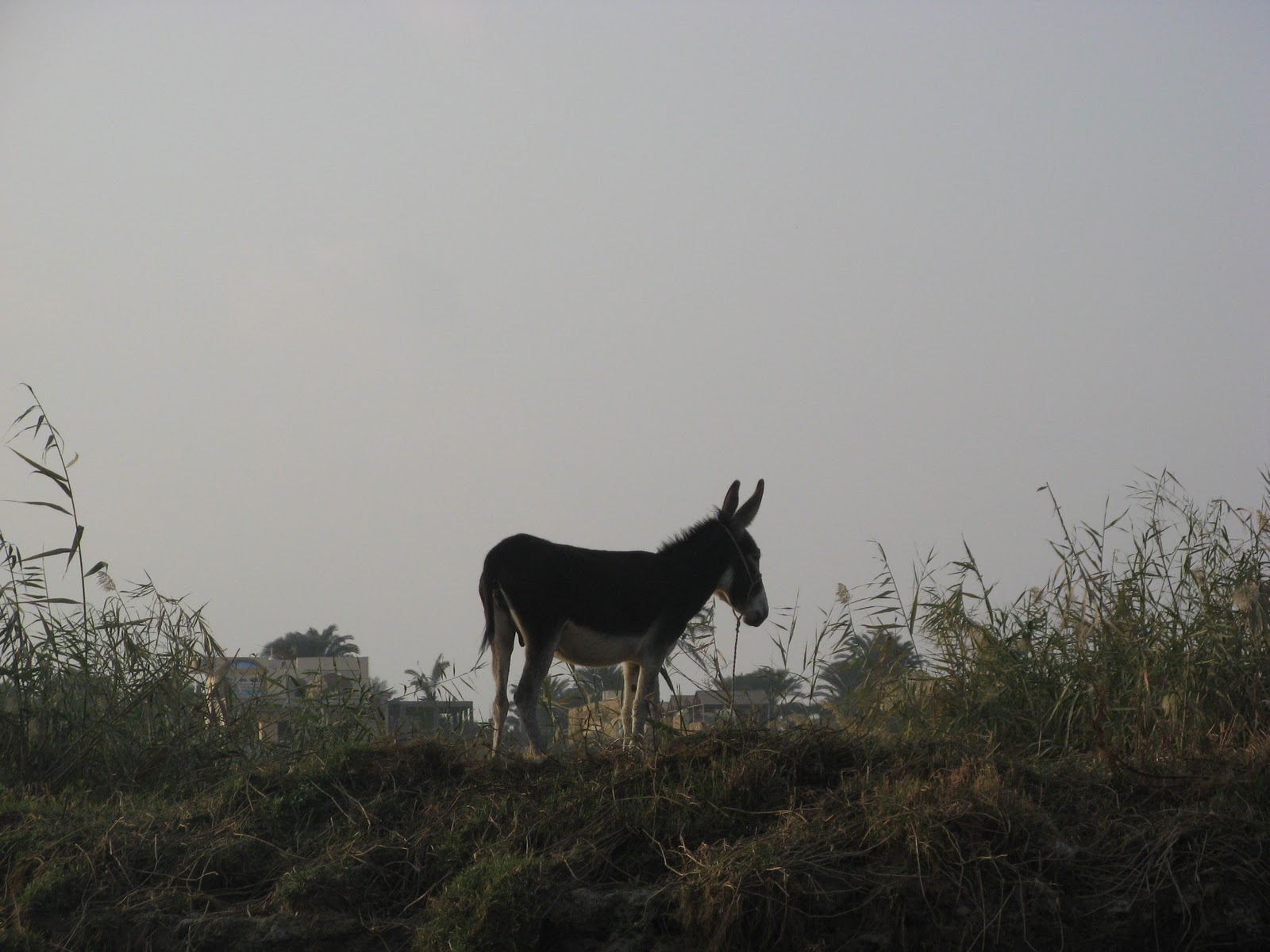
I see at least half dozen donkeys and a few horses, but mostly donkeys, for every car or truck on the road. They carry bundles on their backs, transport people and cluster in the shade of palm trees when not in use.
Small mud huts dot the landscape. I think these are shelters used when working a field and not permanent homes.
They are made from mud and straw bricks like those mentioned in biblical times. They look quite primitive, but no doubt a pleasant respite from the glaring sun. I’m enjoying my train ride so much. It’s like a living museum where life goes on from one generation to the next and change is measured in the millennium.
I start thinking about the two natural phenomena which dominate the landscape - the sun and the Nile water. No modern tourist can visit Egypt without awareness of the bright glaring ever-present sun. It rises in the east and falls in the west only to repeat itself every day. Likewise, the life-giving water of the Nile clearly transforms the dead desert into a living lushness.

It’s a small wonder that these natural phenomena influenced thought and religious development from earliest time. The sun evoked a god called Re, Atum, Horus and a host of other names as one aspect or another is emphasized. He becomes the king of gods.
The Nile becomes the domain of Osiris. His mythology follows the regeneration of life upon the desolate earth after flooding. He becomes identified with death, resurrection and the after-life. To learn more about the Osiris mythology and its interaction with the sun god mythology, go to http://www.touregypt.net/osiriscu.htm I think we still have shadowy remnants of these ideas when we look to the heavens for God and celebrate rebirth every spring.
Now I'm across the street from the Luxor Temple in a bookstore. As serendipity would have it, I find a most interesting book. It's entitled Development of Religion and Thought in Ancient Egypt and is written by James Breasted , an esteemed Egyptologist.
The Great Pyramids of Gizeh were built from 2575 to 2150 BCE and stretch some 60 miles along the edge of the desert. They represent an incredible effort of an entire society through purely material means "to immortalize the king's physical body, enveloping it in a vast and impenetrable husk of masonry, there to preserve forever all that linked the spirit of the king to material life." (Breasted, p 178) I use to think of the Pyramids as a monument commemorating a Pharaoh when actually they are a material place for immortality.
After about 2100 BCE, Pyramids were no longer built and after another 1000 years, they were mostly forsaken, left desolate amidst the shifting sands of time. An age of political disintegration took hold of Egypt. Mournfully, they began to realize the futility of massive masonry to insure immortality. Skepticism ensued and with it, new ideas took root.
The afterlife which had been the sole domain of Pharaoh was democratized to nobles and eventually common people. Osiris and the sun god were redacted into a blended, if not always consistent, theology. By 1300 BCE a new religious order worshipping the sun god Atum was established. Thebes or modern day Luxor was at its center.
Now I am here.
As I stand among colonnades of Luxor Temple or visit Karnak Temple or wander the Valley of the Kings, I feel linked with these places. I realize that the development of human thought once moved through here and now moves through my generations and one day will move into places not yet imagined.
Later that night, we join a group for an evening of star gazing under the desert sky. Climbing a sand dune, we watch the sun go down or is it dying in the west. I now understand how natural phenomena can be given mythological meaning.
We gather around tables to enjoy a delicious Egyptian meal with people from South Africa, France, Holland, England and our Egyptian hosts. We are a diverse human family and yet we come together under the stars.
We are shown the Milky Way, constellations and star clusters. One star, Aldebaran, or the Bull`s eye, is said to be 65 light years away. I gasp, “Yikes, this one started its light path to earth during the year of my birth.”
Of course, other stars are much further away. They say our galaxy is about 120,000 light years in diameter and it is one among billions of other known galaxies.
Gazing into the heavens puts perspective on my Egyptian trip. As ancient as Egypt is, it is but a recent moment in the life of the universe. We are just beginning to send our light to distant places.
Like ancient Egyptians before me, I look up at the colonnade and the stars and I can't help but wonder. What meaning? What stories are yet to be told? What will human life and thought and religion look like in another 5000 years and beyond?
Tuesday, January 11
Egypt: Part II
Today is museum day. We are off to the the Egyptian Museum which is just across the street from our hostel. It was built at the turn of the 19th century and some have called it the "Warehouse of Antiquity" since it crams a lot of artifacts into its two floors without the more modern presentations.
I am eager to see for myself. After a day of surveying the Pyramids, I want to see what the Pharaohs took into the afterlife.
Fran and I queue-up in, not one but two, security lines. I am told later that Egypt has a number of make-work redundancies to keep people employed. We are thoroughly scanned and bags are properly searched.
Cameras are not allowed inside and must be checked. It's interesting to see the big tours companies filling baskets with their clients' cameras - thousands of dollars of digital hardware placed on a shelf with a coat-check token as collateral.

|
|
Sunday, January 9
Egypt: Part I
What happened? Quickly we check for broken bones and scurry out of the way before more people tumble upon us. We are okay with more bruised egos than anything else. We look at each other and think, “How could we be so stupid?” Then uncontrollably, we begin laughing and laughing and laughing.
This incident becomes a metaphor for my trip. Egypt is all about shock and awe. I find myself in places I never thought possible. I experience the intensity and chaos of Cairo and then step into the stately antiquity of the Pyramids. I consciously try to learn to let go of control and just savor the experiences – good, bad or indifferent. It's about enjoying the ride for as long as I can and remembering to jump and not fall off the end.
Cairo is a densely compacted city of 7.8 million with as many as 10 million more people living in close proximity. Intense is an understatement.
Cars whiz along as if trying out for the Indy 500. Three lanes become 4 and sometimes 5 as cars swerve to gain an advantage of a few feet. I’m in the front seat and have to close my eyes more than a few times. Amazingly, I never see an accident although I certainly think one is about to happen. It’s as if cars become an extension of the people driving and they can calibrate the closeness to another within fractions. It’s uncanny.
Car horns beep and blare…constantly. It’s like they are talking to each other. Some taxis have special beepers. They emit a rapid high pitch and crescendo before ebbing in a wave of sound. The cacophony assaults the senses. I think maybe Cairo Egypt is where John Cage got his inspiration for his compositions of sound effects.
I try to cross the intersection to get to the Egyptian Museum which is directly across the street from our hostel. I walk a half a block to a traffic light, but quickly realize that lights are more ornamentation than traffic control. Egyptian drivers ignore them…yikes!
How to get across? At 9:30 am there is no break in the traffic and like I say, traffic lights don’t help. I watch other pedestrians. How do they do it? They boldly walk out in front of the speeding traffic. Of course, car horns blare, “Get out of the way.” The pedestrians extend an arm in a stop motion and then dodge between on-coming traffic. It’s magical. Cars mostly slow down.
I pick out a cluster of Egyptian pedestrians and decide to follow closely. Even though my blood pressure probably shoots up 30 points, I make it. I’m alive. By the end of the trip, I am doing it on-my-own. I just extend my arm in a stop motion and magically cross to the other side. Egypt is Pyramids and the Pyramids are everything you can imagine. However, getting to them is a challenge. We buy a tour from our hostel. It's a mistake. Our “English Speaking” driver has a limited vocabulary - very limited. Try as we do, there is no way to communicate. I now know the frustration my Ukrainian friends feel when they try to communicate with my limited Russian.
Our driver gets us to the Pyramids and then the tourist hustle begins. Everyone seems to have a scheme to help me spend money. It can be the shopkeeper who prices bottled water at 10 Egyptian Pounds when the local rate is 4 EP or it can be the dozens of long robed men trying to grab my attention with a deal not to be missed.
“Come with me....what is your name? This way please....where are you from? I have very good price. What you want…camel…horse…carriage? I get it for you,” they say. I feel like I’m being picked apart by the constant barrage of offers. I’m exhausted going a few hundred feet. It’s a hectic touristy craziness.
I fend off offers…although I am tempted a few times. I’m still a neophyte in the Egyptian bartering system. I don’t know a fair price and I don’t know what may lie ahead. Fran says she yearns for a shop with price tags. We buy tickets to get into the Pyramid area. At 60 EP (less than 12 USD) it's a deal and maybe the only one we will encounter today.
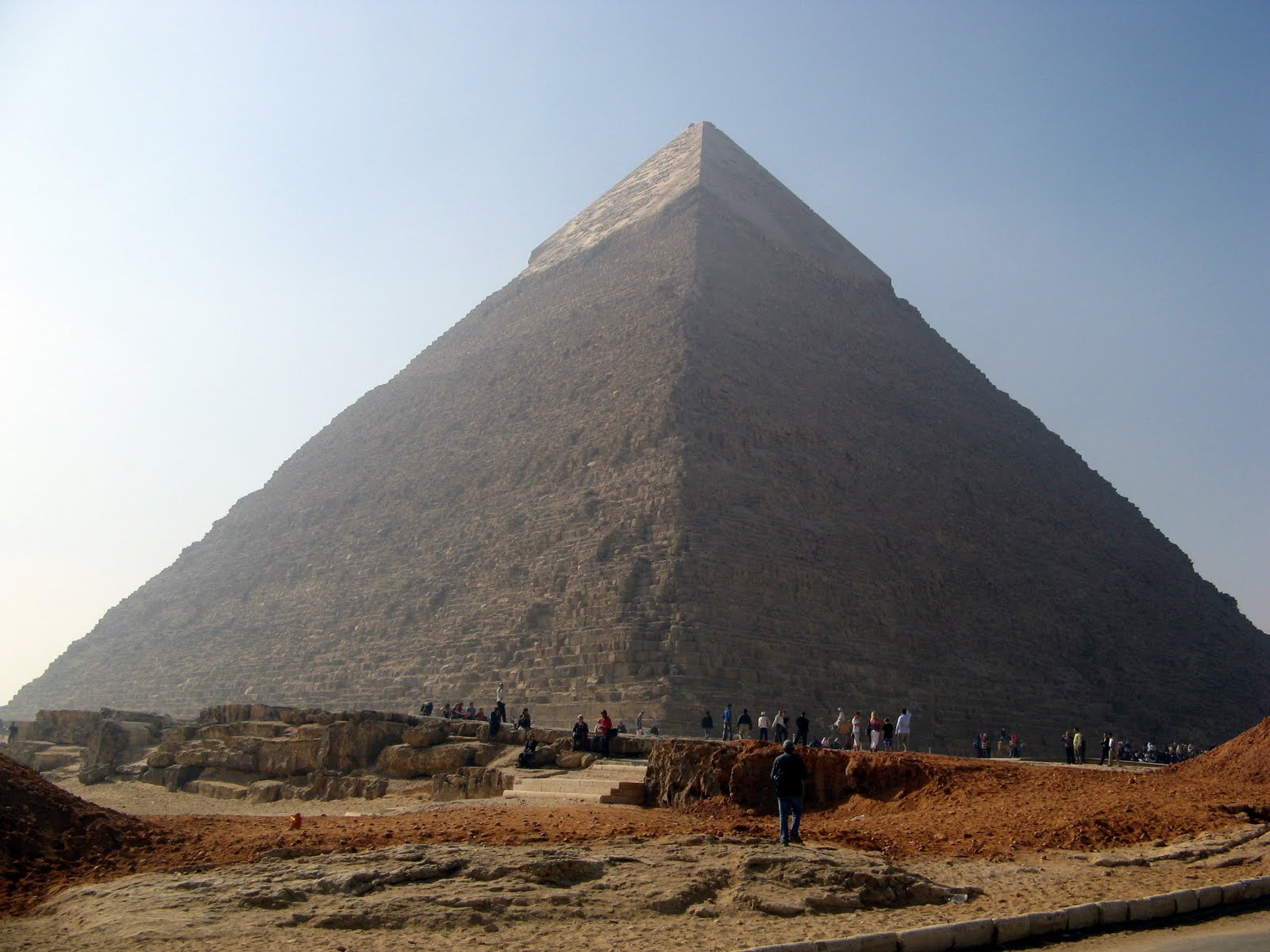
For about an hour he escorts us around the Pyramids. It’s a sunny day with a touch of dusty grayness or is it pollution hanging in the air? I feel like I have walked into a National Geographic layout. All my life I have seen pictures and now I am here gazing at mortuary monuments from Egypt’s Old Kingdom, some 4500 years ago.
The Giza complex includes three large Pyramids for the afterlife of the Pharaohs and three smaller ones for wives. A mortuary temple and complex is attached so that offerings can be made to the god-king and his resurrected life secured for perpetuity.. A causeway has been discovered that connects the colossal monuments and smaller tombs for nobles of the Pharaoh’s Court.
The volume of the largest Pyramid of Cheops is roughly 2,500,000 cubic meters. Based on these estimates and building over a 20 year period, workers (or were they slaves) would have installed about 800 tons of stone every day. Similarly, it means that of the 2.3 million blocks of stone, about 12 would have to be put into place every hour of every day for twenty years.
To learn even more go to http://en.wikipedia.org/wiki/Great_Pyramid_of_Giza
The Pyramid area is so vast that even with many tourists, moments of calm reflection are possible. I realize that here ancient people have made an insistent and passionate protest against death.
The Pyramids are an affirmation to life and a supreme revolt against the darkness and silence from which no one returns. They evoke mystery and deep soulful thinking.
Tuesday, December 21
Snap-Shots From Konotop
Fridays mean Art Day at Hearts of Love Center. Just about every Friday I do some sort of Art Project with the children. It’s become popular to draw or paint with the American.
On some Fridays, I’ve seen as many as 18 kids in space for maybe 10. I do get a little tense and overwhelmed, but with the help of Annya, I keep my cool. She says with a smile, “Normalna. It’s normal.”
Last week, I made a huge Christmas tree by taping together blocks of paper and using my watercolors to paint the branches. Then the children drew ornaments to decorate. All levels and ages contributed. Some of the ornaments are decorated ala scribbles while others are carefully drawn. One medicated boy surprises me. Instead of the usual scribbles, he draws a design for the first time. I say in my best Russian, “Good job…Good Job.”
I always insist that the children put their names on the art. I think by claiming it as their own, a little piece of self-esteem is added to their lives. Often they will take the art to other adults at the Center and bask in the approval.
I am putting away supplies and getting ready to go home, when a little girl bursts into the room. “Chi, Chi, Chi,” she insists. I make my way down the hall to another room where she and a friend are setting the table with china cups and plates – no Styrofoam here.
Then I learn it’s the little girl’s Birthday. She is a 8 years old. Her mother has brought in a small cake for a small celebration. It’s a special treat.
As we settle into our places at the table, we are invited to share a Birthday wish. This is a wonderful Ukrainian ritual. People talk intimately about a person’s character and offer wishes for a good life. Each wish can go on for several minutes. I love the way Ukrainians are not embarrassed to express kindness.
I look at the little girl. She is wearing a red dress. Red is considered most beautiful for Ukrainian women. And this little girl is beautiful in her own special way.

What I notice most is her demeanor. She glows with Bambi eyes wide open. The gentle words of praise accumulate like dozens of presents – but only more valuable. I am touched when her older brother speaks in admiring terms of love. We all should be so blessed.
I place my hand on my heart and take a mental snap-shot.
Whether it's Santa or St. Nicholas, there's magic in the idea that a stranger will come to give gifts. Sometimes it’s expected and other times it happens as a surprise.
At Hearts of Love, the hallways are strung with tinselly garlands. We are having a lot of fun getting ready for our St. Nicholas party. Just when I think all has been done, Yelena finds another box of tinsel. More is better. I tease her that she's decorating this center like a mother with a gang of kids.
My watercolor tree is decorated. The children have covered it with their own creations. I am proud of them. Festive bags have been bought and filled with candies. We are expecting about 35 children.

The story pits a fox and wolf against two little hares with a big old bear as referee. There are chase scenes, deceptions, fisticuffs and more. But in the end all are friends. Ukrainians like animal stories and judging the reaction from the children, they love this one.
After introductions, the Vice Mayor gets right down to business. "How does this organization compare to ones in America," he asks? “Wow,” I think. “How am I going to respond to such a question?”
I talk about the challenge of funding and the need for local support. I offer the idea of a "United Way" approach. He leans forward. He’s interested and asks, “Will you come and meet with the Mayor?”
I’m totally surprised. What an unexpected opportunity!
Then he turns to Yelena and says, “I think we should make a professional video so that the people of Konotop can learn about your work here. “ It’s another unexpected surprise. The meeting ends with exchanges of emails and wishes for a Happy New Year.
Later as I am getting ready to leave, Yelena turns to me, “You told us to widen our circle of friends…You know, we listened….See what’s happening.”
Saturday, December 18
Allies...Enemies...Friends
The story starts with an invitation to speak at School # 5. I have been getting quite a few speaking invites and never know exactly what to expect.
We walk into the assembly hall. It’s packed with students and most look to be from the upper grades. They’re dressed well - no jeans and sweat shirts here. Boys wear dress pants, suit jackets and ties. Girls are in skirts or dresses and many with bows in their hair. For a moment I think it’s 1958 and I am back at St. Cecilia’s Catholic School in Philadelphia.
Today is Ukrainian Army Day. Officially it’s a day to remember the 1991 establishment of the Ukrainian military, but unofficially it’s more about veterans and especially veterans of the Great War (WW II). The director of the School wants to combine honoring veterans’ service with the idea of volunteering and community service. I now know why Yelena, Vika and I are here.
We are escorted to the front of the hall and take our seats behind three older men. They are a living legacy from the Great War. Their chests are festooned with ribbons and medals. I see the profile of Lenin and madallions with the hammer and sickle on many.
To an American, it looks strange to see so many military medals on an ordinary civillian suit jacket. But then as an American, I have never known such a pervasive and devastating war on my home soil. What memories they must hold on their chests.
The program unfolds in typical Ukrainian style. Two students read from a scripted program to welcome and introduce each segment. They do a great job. After introductions, a young woman sings a hauntingly beautiful patriotic song.
Then we are shown a slide presentation. It’s visually haunting as well. I see a slide of army boys crouched at a window looking out at war-torn buildings. Then I glance at the windows in this hall and shiver. The window style is the same. The photo could have been taken from a place just like here. And maybe, it was.
The Veterans take turns addressing the students. I kept thinking that they were not much older than the oldest student here when they went to war. I notice a young boy across the aisle from me. He is on the edge of his seat absorbing every word. Judging from the intense silence in the room, everyone is doing the same. The speaker begins to weep.
I wish I knew what he was saying, but I later find out he was speaking in Ukrainian and I only know a little Russian. So I sit absorbing emotion and offering empathy.
Yelena speaks next and her warm charm provides an excellent transition. Her pictures of a broken down building being transformed into a lively Center for disabled children tells a powerful story of volunteer drive and the positive difference a few people can make. She speaks from the heart just as the Veterans had done, but she speaks about living and loving and hope.
My turn comes next. I start with JFK’s famous phrase – “Ask not what your Country can do for you, but what you can do for your Country.” I talk about the Peace Corps. I tell the students that right now more than 8,500 Americans are serving in 77 countries around the world. They share skills, like I do here in Konotop. They make new friends and kindle cross-cultural understanding.
I end my short talk by applying JFK’s words to Ukraine. “Ask not what Ukraine can do for you, but what you can do for Ukraine… for Konotop…for your city. “ The applause is loud and sustained.
As I take my seat Yelena smile. Each of the Veterans turns around to shake my hand. As the third one does so, he pulls me closer and before I know what is happening, he firmly plants a kiss on my hand. This military man with a chest full of medals and memories has tears in his eyes.
Allies…Enemies…Friends.
Monday, November 29
What About God's Justice???
I have known Paul and Darlene Heller since my days at Pittsburgh Theological Seminary. Yikes, that’s more than 40 years ago. Paul and I met and became close friends. I never realized back then that we would still be good friends in 2010.
Darlene found Paul (or was it the other way around) when he was in NYC serving an internship at the East Harlem Protestant Parish - a groundbreaking ministry among the poor. Darlene was studying to be a nurse. They fell in love and Darlene came back to Pittsburgh with Paul. Marriage soon followed.
Over the years our friendship deepened. For more than 20 years, ever since my divorce and its brokenness, I have spent every Thanksgiving and Christmas with the Hellers. The kids, Adam, Caleb and Rebekah adopted me along with their spouses Sara and Andrya. We are family and I am delighted.
One time I was visiting and had a nightmare. I woke up shouting, "WHAT ABOUT GOD'S JUSTICE???" It was loud enough to wake the Hellers. Over coffee the next morning, we laughed about my active imagination and theological musings – even in sleep. It became one of those family stories that gets repeated over turkey.
Fast forward to present time. Paul and Darlene leave Plattsburgh, New York with all its snow and skiing for the tropics of Malawi. Yes, for two and a half years, Paul and Darlene Heller, have been in Malawi Africa.
Darlene has been directing the Mzuzu Crisis Nursery. They take in babies who have been abandoned for a variety of reasons. Often their mothers have died in childbirth or there has been some other difficulty in the village. When the babies come, they are mostly in a wasted state.
Paul has been working on the administrative side strengthening administrative practices and securing a more stable financial base. It’s crucial work.
He also has been preaching at the local church where 1000 people regularly attend. That’s right, one-thousand people – imagine! He tells me that worship services often go on for 3 hours and even more. I tell him he needs shorter sermons (chuckle).
The work at the Mzuzu Crisis Nursery is literarily life-saving. It will probably never reach the headlines of the NY Times or the air waves of NPR – although you might easily argue that it should.
Another baby is brought to the Mzuzu Crisis Nursery
Day-in and day-out, babies are being nursed back to health. They come as frightened skeletons and become chubby cherubs. Of course, sometimes a baby arrives too late. All that can be done is hold the little one until she dies. It’s hard work. And I think it takes a lot of soulfulness to do it. My good friends have soul and faith and love.
The same baby after two months of food and care
Take a moment to review their blog. The context is heart-wrenching, but the work is heart-enlightening. http://www.suffer-the-little-children.blogspot.com/
I keep thinking that among the lives being rescued at the Mzuzu Nursery, there are those who will make a difference in Africa’s poorest country. Thank you, Paul and Darlene, for being an answer to my dream – “What about God’s Justice?”
Wednesday, November 24
Today I Graduated
Ever since arriving in Ukraine, I have taught beginner’s English. Most Peace Corps Volunteers have at least one class. Many have several. During our Peace Corps training they told us that while being new in a community, English could be used as a kind of social currency. It gives us something useful that Ukrainians want and it occupies us as we try to figure out what’s going on.
So whether it’s been with children or adults, mothers at the Center or governmental leaders, I have taught English. It’s been fun to introduce participatory classes and get my students talking in English. We progress from simple verb tenses to pronoun charts to prepositional phrases and more. We make-up simple sentences and dialogues about family, friends and weather. Progress is slow and it’s been at an elementary level.
That's why I am pleased to receive an invitation to teach at the Technical School.
"Can you come and be with our advanced English students? They do not have many chances to talk with native speakers. Your presence will be a great pleasure for them,” says Tatyanna, one of the English teachers.
I agree to teach and we begin to discuss particulars - What kind of class; how many students; and so forth? Tatyanna tells me that there will be about 25 students, maybe a few more. "Like I said, it will be a pleasure for them,” she says. And I think it will be very interesting for Tatyanna and the other teachers as well.
We decide to read portions of Taras Shevchenko’s poetry. He is a renowned Ukrainian poet (and painter) who captures the long suffering of his people and the ever present hope for rebirth. His influence on Ukrainian culture is immense.
During Soviet times, his strong patriotism was downplayed in favor of his anti-czarist sentiments. However Shevchenko was always a Ukrainian patriot. He was a serf and stood up for the plight of the poor. Today he is an iconic figure even appearing on Ukrainian 100 grievnah bill. (adapted from Wikipedia)

Also we decide to read portions of Martin Luther King's I Have a Dream speech. His dream of America living up to the ideals of our Founding Fathers echoes Shevchenko's dream for a just and free Ukraine. I hope this class will add to our cross-cultural understanding. We all struggle for a better life.
I arrive early for the class. I can tell that the teachers are nervous - a little for me, but more for their students who they hope will do well and that I will have patience with them. Tatyanna confides, "They have never had such a class."
Students arrive. It is a full house. Extra chairs are brought in from across the hall. Unlike most of the classes I have taught, young men outnumber the women here.
I ask, "Do you speak English?" And I am pleased to hear a loud response, "Yes, we speak English." The class proceeds with readings from Shevchenko’s poignant poem. Some have read it before in Ukrainian, but now we read an English translation.
…Break then your chains, in love unite,
Nor seek in foreign lands the sight
Of things not even found above,
Still less in lands that strangers love...
Then in your own house you will see
True justice, strength, and liberty…
…Then all the shame of days of old,
Forgotten, shall no more be told;
Then shall our day of hope arrive,
Ukrainian glory shall revive,
No twilight but the dawn shall render
And break forth into novel splendour....
Brother, embrace! Your hopes possess,
I beg you in all eagerness!
Taras Shevchenko, Viunishcha, December 14, 1845

We continue with King's speech and note the similarities of these two patriots from countries half a world apart. We discuss a little about justice and freedom and how liberty is justice with freedom. We are having a substantive class and discussion in English. It’s great.
As we wind down the class, I have a surprise. I show the words of a 1960s song. It's a song I sang often with other volunteers when I first tried the Peace Corps in 1967. Now more than 40 years later, I am teaching If I had a Hammer to Ukrainians. Who would have thought it possible?
...it's the hammer of justice, it's the bell of freedom, it's a song about love between my brothers and sisters all over this land....
Sunday, November 21
Ordinary Life: Potpurri
>>>One morning on my way to a Marshuka, I spy a old babushka emerging from the tree-line that surrounds an open field not far from my building. I give her a causual glance and begin to turn attention elsewhere when I notice four goats following her. They grab my attention.
The goats are grazing on a mixture of leftovers from the field and weeds. The babushka is bent over gathering some of the same weeds, maybe herbs.
Even when she stands up, she is still bent over. It's a common sight among older woman who, no doubt, have had years of back-breaking work - literally. She's dressed in a peasant skirt, heavy stocking to her knees, layers of sweaters and an overly large coat. Nothing matches. A colorful scarf wraps her head. Slowly and deliberately she moves plucking weeds and using her walking stick for balance. The goats follow. I stare. It’s another National Geographic moment.
>>>Synergy is a neat word. Don’t you like the way the syllables roll around the mouth before emerging? And even neater is the way it keeps showing up.
I am sitting in the audience while Hearts of Loves second charity auction unfolds. Last year I played a central initiating role, but not now. Plans for the auction were well under way before I knew it. The idea of local fund raising has taken root.
This year a group of university students volunteered to help. They reached out to businesses for donations and orchestrated the entire evening complete with music, entertainment, auctioneers and lovely "Vanana White" type young women who parade among the audience with each item for bid. It’s a charming sight.
I think they are feeling bad that I do not have a larger role this year. They are wrong. When I am asked to share a greeting, I say how proud I am of these young leaders. Everyone applauds.
Last Spring these young people were among those who shared in my Leadership Seminars. Now they are joining Hearts of Love to raise more money for this year's heat. Synergy is happening in Konotop.
>>>Anton, my young Ukrainian friend, tells me a family story. When his father was his age, nineteen, a Soviet military recruiter came to their small village. At the time, the Soviets were involved in a in a blood draining war. The place was Afghanistan.
The young men of the village were rounded up. There were 35 of them including Anton’s father. On that day, everyone was scheduled to go to Afghanistan. After paper-work, they would be packed in trucks for the long journey away to war. I can hardly imagine the impact this must have had on a small village.
Anton’s Grandfather knew that if he could delay his son’s departure by a few days, he would likely be assigned to Kazakhstan and not Afghanistan. So he acted to save his son.
On the day of the round-up, he brings a hog and a lot of vodka to the recruiter. He says something like, "my son is needed at home. Can he go next week?" It works. The paper-work is misfiled. Anton’s father is passed over for a few days.
As Anton tells me this story, I get a chill. I realize that without his Grandfather’s action he would probably not be here. Of the 34 recruits sent to Afghanistan that day, only 5 returned.
Probably most people are not faced with dramatic situations like this one. Yet I get to thinking that kind and generous actions, even small ones, can make a difference from this generation to another and another.


![M17 [i] i](http://en.wikipedia.org/w/extensions/wikihiero/img/hiero_M17.png)
![Y5 [mn] mn](http://en.wikipedia.org/w/extensions/wikihiero/img/hiero_Y5.png)
![N35 [n] n](http://en.wikipedia.org/w/extensions/wikihiero/img/hiero_N35.png)
![X1 [t] t](http://en.wikipedia.org/w/extensions/wikihiero/img/hiero_X1.png)


![S38 [HqA] HqA](http://en.wikipedia.org/w/extensions/wikihiero/img/hiero_S38.png)
![O28 [iwn] iwn](http://en.wikipedia.org/w/extensions/wikihiero/img/hiero_O28.png)
![M26 [Sma] Sma](http://en.wikipedia.org/w/extensions/wikihiero/img/hiero_M26.png)